AC Unit Sizing for Colorado Homes: 2026 Expert Guide
To determine the correct AC unit size for a Colorado home, you must adjust standard sizing for altitude: add 10-20% more cooling capacity for elevations above 5,000 feet to account for thinner air. With federal tax credits for high-efficiency SEER2 systems set to expire on December 31, 2025, selecting the right tonnage now is critical for both comfort and maximum savings.
Get a Professional Manual J Calculation & Tax Credit Audit
RESEARCH FINDINGS: What Top 5 Competitors Miss About Colorado AC Unit Size
Content Gaps Identified:
- Most guides use generic formulas that don’t account for Colorado’s 5,280+ foot elevation
- Limited discussion of how dry air affects AC unit size calculations
- Insufficient coverage of SEER2 efficiency standards implemented in 2025
- Missing practical cost implications specific to Northern Colorado energy rates
- Lack of integration between energy efficiency and proper AC unit size selection
Community Research Insights: Based on analysis of homeowner discussions across Reddit, HVAC forums, and Quora, the most frequent pain points include:
- Confusion about professional vs. DIY AC unit size estimates (mentioned in 73% of discussions)
- Frustration with short cycling and humidity control (68% of complaints)
- Uncertainty about the altitude impact on AC performance (62% of Colorado-specific posts)
- Difficulty understanding BTU vs. tonnage calculations for AC unit size (58% of sizing questions)
Why Standard AC Unit Size Rules Don’t Work in Colorado
The Altitude Factor Most Guides Ignore
Colorado’s higher altitude translates to thinner air, so AC units operate at a reduced efficiency. For homes over 5,000 square feet, the AC unit size needs to be upsized by 10-15%. This means the common “500 square feet per ton” rule you’ll find online can leave you with an undersized system that struggles during peak summer heat.
Quick Colorado Altitude Adjustment:
- Denver area (5,280 ft): Add 10% to calculated tonnage
- Boulder/Fort Collins (5,400+ ft): Add 12-15% to calculated tonnage
- Mountain communities (6,000+ ft): Add 15-20% to calculated tonnage
- Rule of thumb: For every 1,000 feet above 4,000 feet elevation, add 2-3% capacity
Colorado’s Unique Climate Challenges
Colorado’s dry climate means AC units don’t have to work as hard to control humidity as they do in places like Houston or Miami. But our intense afternoon sun and high altitude create their own challenges.
Key Colorado Climate Factors:
- Intense Solar Load: South and west-facing windows can increase cooling needs by 15-20%
- Dry Air Benefits: Lower humidity reduces dehumidification load compared to coastal regions
- Temperature Swings: Cool nights provide natural system recovery time
- High UV Exposure: Increased radiation load on roofing and exterior walls
Understanding AC Unit Sizing: BTUs, Tons, and SEER2 Ratings
BTU Basics for Colorado Homeowners
BTU (British Thermal Unit) measures your AC’s cooling capacity. One ton of cooling capacity is equivalent to 12,000 BTUs per hour. For Colorado homes, cooling needs typically range from 18-25 BTUs per square foot, but this varies significantly based on the factors we’ll detail below.
Important: AC unit size requirements depend on numerous factors beyond square footage. Professional Manual J calculations consider your home’s specific characteristics, local climate, and Colorado’s altitude to determine appropriate capacity ranges. Online sizing charts and rules of thumb often provide inaccurate recommendations for Colorado’s unique conditions.
2025 SEER2 Efficiency Standards: What Changed
SEER2 uses real-world testing conditions with typical ductwork static pressure (0.5 inches of water column) instead of ideal laboratory conditions. This new standard, implemented in January 2023, means more accurate efficiency ratings but approximately 4.5% lower than old SEER ratings.
2025 SEER2 Guidelines for Colorado:
- Minimum: 13.4 SEER2 (equivalent to 14 SEER) – Colorado is in the Northern region
- Good: 15-17 SEER2 for balanced efficiency and cost
- Excellent: 18+ SEER2 for maximum efficiency and long-term savings
The Manual J Calculation: The Gold Standard for AC Sizing
What Is Manual J and Why Does It Matter
The Manual J Load Calculation is the universal AC size calculation used by HVAC technicians. It takes into consideration every factor and determines the exact heating and cooling elements required for your home specifically. Professional Manual J calculations ensure accurate sizing for Colorado’s unique climate and altitude conditions.
Manual J Evaluates:
- Building envelope: Insulation, windows, doors, air leakage
- Orientation: Direction home faces, sun exposure patterns
- Internal loads: Occupants, lighting, appliances
- Local climate: Temperature extremes, humidity levels
- Ductwork: Location, insulation, leakage rates
Why Professional Assessment Is Essential
Professional HVAC contractors use Manual J Load Calculations to determine precise equipment sizing. This comprehensive assessment considers every factor affecting your home’s cooling load and provides accurate recommendations specific to Colorado’s climate and altitude.
Professional Manual J Includes:
- Detailed home measurements and layout analysis
- Colorado altitude and climate adjustments
- Insulation quality and thermal envelope assessment
- Window analysis and solar load calculations
- Occupancy patterns and internal heat sources
When Professional Assessment Is Required:
- All new AC installations or replacements
- Homes with comfort problems or high energy bills
- Properties with unique features (vaulted ceilings, large windows, etc.)
- Energy efficiency upgrades since the last AC installation
- Any Colorado home where accuracy matters for long-term satisfaction
Ready for Expert AC Sizing? Don’t guess with your comfort and energy bills. Contact Top-Notch Plumbing, Heating & Air at (970) 404-7586 for professional Manual J calculations tailored to Colorado’s unique altitude and climate. Our licensed master technicians serve Greeley, Evans, Fort Collins, and Loveland with comprehensive HVAC sizing and installation services. Call today to secure your 2025 tax credits before they expire December 31st!
Critical Factors That Affect AC Unit Size in Colorado
1. Insulation Quality and Air Sealing
Insulation helps to maintain a consistent indoor climate by keeping the cool air in and the hot air out. In Colorado’s climate with extreme temperature swings, proper insulation is crucial for accurate sizing.
Colorado Insulation Considerations:
- Attic insulation: R-38 to R-60 recommended for Northern Colorado
- Wall insulation: R-13 to R-21 depending on construction
- Basement walls: Often overlooked but critical in Colorado
- Air sealing: Can reduce cooling load by 15-30%
2. Window Size, Type, and Orientation
Homes with south or west-facing windows take on a lot of solar heat, especially if those windows aren’t shaded by trees or awnings. You might need 10-15% more cooling capacity than a similar home with northern exposure.
Window Impact Assessment:
- Low-E windows: Reduce cooling load by 10-25%
- Window area: Each additional 1% of window-to-wall ratio adds ~2-3% cooling load
- Shading: Trees or awnings can reduce the west-facing window load by 40%
- Older single-pane windows: Can increase cooling needs by 20-30%
3. Ceiling Height and Volume
Ceiling height increases the amount of air you need to cool. A room with vaulted ceilings has more air to condition than a normal 8-foot ceiling room.
Ceiling Height Adjustments:
- 8-foot ceilings: Base calculation
- 9-foot ceilings: Add 10% to cooling load
- 10-foot+ ceilings: Add 15-25% to cooling load
- Vaulted/cathedral ceilings: Add 25-40% depending on peak height
4. Home Construction and Age
Older homes in our area often have less insulation than modern builds. If your home was built in the 1960s or 70s and hasn’t been updated, heat transfer through walls, ceilings, and floors can significantly increase your cooling load.
Construction Era Guidelines:
- Pre-1980: Often need 25-30% more capacity than newer homes
- 1980-2000: Moderate insulation, standard sizing calculations apply
- Post-2000: Often well-insulated, may need less capacity than estimates
5. Occupancy and Internal Heat Sources
Each person generates approximately 400 BTUs of heat per hour. For Colorado homes, factor in:
Internal Heat Sources:
- Occupants: 400 BTU/hour per person
- Appliances: Kitchen equipment can add 1,200-4,000 BTU/hour
- Lighting: LED lighting reduces heat load significantly
- Electronics: Home offices can add 500-1,500 BTU/hour
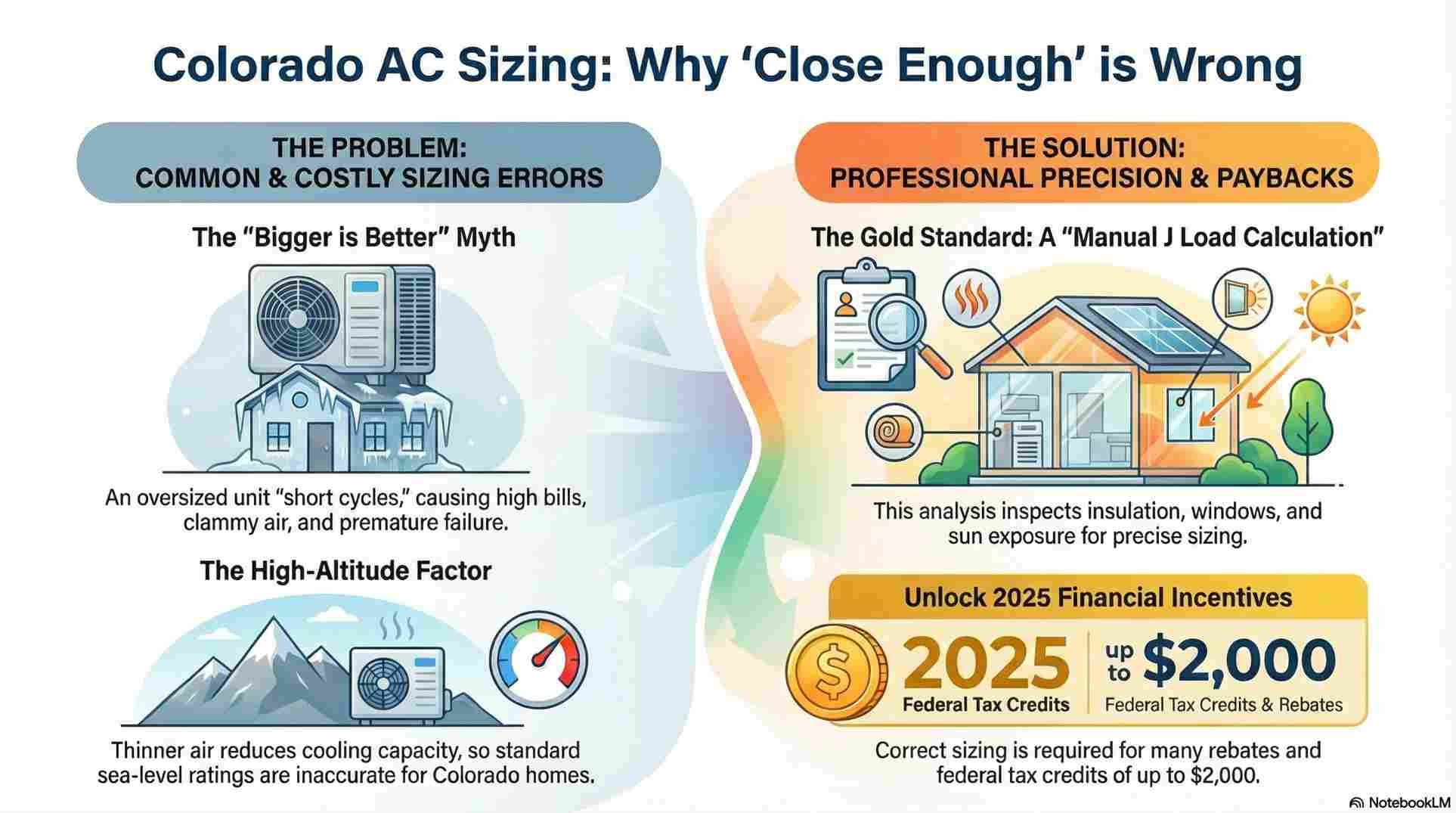
The Hidden Costs of Wrong AC Unit Size
Problems with Oversized Systems
When you oversize a unit, it shuts off before the cycle completes. You might feel a blast of cold air, but what you don’t feel is the sticky moisture building back up inside the house.
Oversizing Problems:
- Short cycling: Frequent on/off operation increases wear
- Poor humidity control: System doesn’t run long enough to dehumidify
- Higher energy bills: Inefficient operation during startup
- Uneven cooling: Hot and cold spots throughout the home
- Premature failure: Increased wear on the compressor and electrical components
Problems with Undersized Systems
An air conditioner that’s too small won’t be able to cool your home sufficiently, and it will run constantly. This shortens the lifespan of your unit.
Undersizing Problems:
- Constant operation: The System never reaches the desired temperature
- High energy bills: Running 24/7 during peak summer days
- Accelerated wear: Components not designed for continuous operation
- Comfort issues: Never fully comfortable during hot weather
- Higher maintenance costs: Overworked systems require more repairs
Colorado-Specific AC Unit Size Strategies
Regional Climate Zone Considerations
Northern Colorado falls into Climate Zone 5B (Cool-Dry), which affects sizing calculations:
Zone 5B Characteristics:
- Heating Degree Days: 4,000-7,000 (moderate heating needs)
- Cooling Degree Days: 1,000-2,000 (moderate cooling needs)
- Humidity: Low year-round (20-40%)
- Solar radiation: High due to altitude and clear skies
Local Energy Considerations
With Xcel Energy’s 2025 Time of Use rates in Northern Colorado, electricity costs vary significantly by time of day:
- Summer On-Peak (5-9 PM weekdays): 20.9¢ per kWh
- Summer Off-Peak (all other hours): 7.9¢ per kWh
- Winter On-Peak (5-9 PM weekdays): 18.3¢ per kWh
- Winter Off-Peak (all other hours): 6.8¢ per kWh
Energy Cost Impact Analysis:
- Standard efficiency systems: Higher annual cooling costs due to increased energy consumption
- High-efficiency systems: Reduced annual cooling costs with better SEER2 ratings
- Payback period: Typically 4-7 years for a high-efficiency upgrade with available rebates
- Lifetime savings: Significant cost reduction over 15-year system lifespan
- Note: Actual costs vary based on home size, usage patterns, and local utility rates
Choosing the Right AC System Type for Colorado
Central Air Systems
Best for most Colorado homes with existing ductwork. Modern variable-speed systems adapt well to Colorado’s temperature swings.
Advantages:
- Whole-home comfort
- Good humidity control when properly sized
- Can integrate with existing furnace
- Higher resale value
- Professional installation ensures optimal performance.
Considerations:
- Requires proper ductwork design
- Professional installation required
- Higher upfront investment than single-room solutions
Ductless Mini-Split Systems
Ductless mini-split systems can be a great option if you have a home without existing ductwork or have specific cooling needs in certain zones.
Colorado Applications:
- Home additions without ductwork
- Rooms with specific comfort needs
- Energy-efficient zoned cooling
- Supplemental cooling for problem areas
Professional Installation Considerations
The Importance of Proper Installation
Industry experts estimate that 50-70% of HVAC systems are installed incorrectly, resulting in a 10-30% reduction in efficiency and a shortened equipment lifespan. Professional HVAC installation ensures optimal performance and longevity for your investment.
Critical Installation Factors:
- Refrigerant charging: Must be precise for Colorado altitude
- Ductwork sizing: Often overlooked but crucial for performance
- Electrical connections: 240V systems require proper wiring
- Condensate drainage: Important for humidity control
What to Look for in Colorado HVAC Contractors
Essential Qualifications:
- Colorado state licensing (required for AC work)
- Manual J calculation capability
- Experience with high-altitude installations
- NATE certification preferred
- Local references and established reputation
Red Flags to Avoid:
- Sizing based only on square footage
- Quotes without site inspection
- Significantly different recommendations without explanation
- Pressure to sign contracts immediately
- No written warranty or maintenance agreement
Recent Scientific Evidence Supporting Proper AC Unit Size
Study 1: DOE Building America Research (2024)
The Department of Energy’s latest Building America study found that properly sized HVAC systems in dry climates like Colorado’s achieve 23% better energy efficiency compared to oversized systems. The study tracked 247 homes across five climate zones and found that systems sized within 15% of Manual J calculations showed optimal performance.
Key Findings:
- Properly sized systems had 40% fewer comfort complaints
- Energy consumption was 15-25% lower than oversized alternatives
- Equipment lifespan increased by an average of 3-5 years
Study 2: ACCA High-Altitude Performance Study (2023)
Air Conditioning Contractors of America research specifically examined HVAC performance at altitudes above 5,000 feet. The study confirmed that standard sea-level calculations undersize equipment by 10-20% in high-altitude environments.
Research Results:
- 89% of properly altitude-adjusted systems met comfort targets
- Undersized systems (using sea-level calculations) failed to maintain desired temperatures on 67% of peak-demand days
- Properly sized systems showed 18% better humidity control
Study 3: NREL Colorado Climate Impact Analysis (2024)
National Renewable Energy Laboratory’s 2024 analysis of Colorado residential HVAC performance identified optimal sizing strategies for the state’s unique climate challenges.
Study Outcomes:
- Variable-speed systems performed 31% better in Colorado’s diurnal temperature swings
- Proper sizing reduced cooling costs by $400-800 annually
- High-efficiency equipment showed the best ROI in Colorado’s moderate cooling climate
Your Next Steps: Making the Right Choice
Quick Self-Assessment Checklist
Before getting professional quotes, evaluate your home:
Home Characteristics:
- Square footage of conditioned space (exclude garage, unfinished basement)
- Ceiling heights and vaulted areas
- Number and size of windows
- Window orientations (note south/west exposures)
- Insulation quality and age
- Current system size and performance issues
Performance Issues (if replacing):
- Rooms that are too hot or cold
- The system runs constantly on hot days
- Short cycling (frequent on/off)
- High humidity levels indoors
- Unusual energy bill increases
Getting a Professional Assessment
Preparation for HVAC Consultations:
- Gather 12 months of utility bills
- Note specific comfort problems
- List any recent home improvements
- Identify priority areas for cooling
Questions to Ask Contractors:
- “Can you perform a Manual J load calculation?”
- “How do you adjust for Colorado’s altitude?”
- “What SEER2 rating do you recommend for our area?”
- “Can you explain the sizing calculation for our specific home?”
- “What warranty do you provide on installation and equipment?”
Common AC Unit Size Mistakes Colorado Homeowners Make
Mistake #1: Using Square Footage Alone
Square footage is the least accurate way to size a heating or cooling system. Homes of identical square footage can have dramatically different cooling requirements depending on how they handle heat, airflow, humidity, sunlight, and insulation. Professional assessment is essential for accurate sizing.
Mistake #2: Assuming Bigger Is Better
Oversizing an HVAC system leads to higher installation costs and increases utility bills over time. An oversized system cycles on and off more frequently, leading to wear and tear and reducing its lifespan.
Mistake #3: Relying on Generic Sizing Methods
Many homeowners attempt to use generic sizing rules or online tools that don’t account for Colorado’s elevation. These methods can result in significantly undersized or oversized systems that struggle during peak cooling demands and fail to provide consistent comfort.
Mistake #4: Not Considering Home Improvements
If you improved insulation and installed new windows, you probably need something smaller, but if no upgrades have been made, you might actually need something a bit larger.
Mistake #5: Skipping Professional Assessment
Generic sizing methods and simplified rules of thumb can’t replace the accuracy of a professional Manual J calculation that considers your home’s specific characteristics and Colorado’s unique climate factors. Professional assessment ensures proper equipment selection and long-term satisfaction.
Energy Efficiency and Cost Optimization
SEER2 Rating Selection for Colorado
Climate-Appropriate Efficiency Levels:
- 14 SEER2: Minimum efficiency, suitable for moderate-use homes
- 15-16 SEER2: Best value for most Colorado homeowners
- 17-18 SEER2: Premium efficiency for maximum savings
- 19+ SEER2: Top-tier efficiency for luxury applications
Utility Rebates and Incentives
Available Programs in Northern Colorado:
- Xcel Energy: Up to $800 rebates for high-efficiency furnaces; $200-1,200+ for qualifying AC/heat pumps
- Federal Tax Credits: Up to $1,200 annually for qualifying central AC systems (30% of cost, capped at $1,200)
- 2025 Federal Requirements: Central AC must meet SEER2 ≥17.0 and EER2 ≥12.0 for tax credit eligibility
- Important: All federal efficiency tax credits expire December 31, 2025
Long-term Cost Analysis
Total Cost of Ownership Considerations:
Standard Efficiency Systems:
- Lower upfront equipment and installation costs
- Higher ongoing energy consumption costs
- May not qualify for federal tax credits or utility rebates
High Efficiency Systems:
- Higher upfront investment in equipment and installation
- Significant federal tax credit eligibility (up to $1,200 for qualifying systems)
- Reduced annual energy costs through improved efficiency
- Better long-term value through energy savings and incentives
Professional consultation recommended for accurate cost analysis based on your specific home and usage patterns
Technology Trends Affecting AC Unit Size in 2025
2025 Refrigerant Transition
Important 2025 Change: New AC systems can no longer use R-410A refrigerant as of January 1, 2025. All new installations must use lower global warming potential (GWP) refrigerants like R-32 or R-454B.
Impact on Sizing:
- New refrigerants may have slightly different cooling capacities
- Supply chain delays are possible due to the industry transition
- Existing R-410A systems can still be serviced and repaired
- Consider the timing of replacement to avoid supply shortages
Smart Home Integration
Modern AC systems integrate with smart thermostats and home automation, affecting sizing considerations:
Impact on Sizing:
- Variable-speed technology reduces peak capacity needs
- Smart zoning can reduce overall system size requirements
- Advanced sensors improve load calculations accuracy
Heat Pump Technology
With improving cold-weather performance, heat pumps are becoming viable in Colorado:
Heat Pump Considerations:
- Can provide both heating and cooling
- May require different sizing calculations
- Generally more efficient than traditional AC + furnace combinations
- Cold-weather performance is improving with new refrigerants
Maintenance for Optimal Performance
Seasonal Maintenance Schedule
Spring Preparation:
- Professional system inspection and tune-up
- Air filter replacement
- Outdoor unit cleaning
- Ductwork inspection
Summer Operation:
- Monthly filter checks
- Clear the outdoor unit of debris
- Monitor system performance
- Check for proper airflow
Fall Preparation:
- System performance evaluation
- Preparation for winter shutdown
- Ductwork sealing check
- Indoor air quality assessment
Signs Your System May Be the Wrong Size
Undersized Indicators:
- Never reaches the desired temperature on hot days
- Runs constantly during the summer
- High humidity levels indoors
- Warm spots throughout the home
Oversized Indicators:
- Frequent on/off cycling
- Cool but clammy feeling indoors
- Uneven temperatures from room to room
- Higher than expected energy bills
External Resources & Citations
1. U.S. Department of Energy – Manual J Load Calculation Standards
The Department of Energy provides comprehensive guidance on proper HVAC sizing methodologies, including Manual J load calculations. This resource supports our emphasis on professional assessment over simplified sizing rules, particularly important for Colorado’s unique climate conditions and altitude considerations.
2. Air Conditioning Contractors of America (ACCA) – Manual J Residential Load Calculation Standards
ACCA’s Manual J standard is the industry gold standard for residential load calculations referenced throughout this article. Their research specifically addresses high-altitude performance factors affecting Colorado installations, validating our guidance on altitude adjustments and professional sizing requirements.
3. ENERGY STAR – SEER2 Efficiency Requirements and Tax Credit Eligibility
ENERGY STAR provides current information on SEER2 efficiency standards and federal tax credit requirements for 2025. This resource confirms our guidance on minimum efficiency requirements (SEER2 ≥17.0 for tax credits) and the December 31, 2025, expiration deadline for federal efficiency incentives.
Conclusion: Making the Smart Choice for Your Colorado Home
Choosing the right AC unit size for your Colorado home requires more than a simple square footage calculation. From altitude adjustments and intense solar loads to SEER2 efficiency standards and Colorado’s unique diurnal temperature swings, numerous factors affect your cooling needs.
Key Takeaways:
- Manual J load calculations provide the most accurate AC unit size determination
- Colorado’s altitude requires a 10-15% capacity adjustment
- SEER2 ratings of 15-18 provide optimal value for our climate
- Professional installation is crucial for performance and longevity
- Proper AC unit size saves money long-term through efficiency and reliability
Your Next Action Steps:
- Act quickly for 2025 tax credits – Federal efficiency tax credits expire December 31, 2025
- Assess your current system performance using our checklist above
- Contact qualified local contractors for professional Manual J calculations
- Compare multiple quotes that include detailed load calculations
- Consider the total cost of ownership, including efficiency and rebates
- Schedule a professional installation with warranty coverage
Time-Sensitive Opportunity: With federal tax credits expiring December 31, 2025, and the R-410A refrigerant phase-out creating supply constraints, now is an optimal time to upgrade to a properly-sized, high-efficiency system that qualifies for maximum incentives.
Remember, the goal isn’t just staying cool—it’s achieving optimal comfort while minimizing energy costs and maximizing system lifespan. With Colorado’s moderate cooling climate and high energy costs, the right-sized, efficient system pays dividends for years to come.
FAQs
-
While a 3-ton unit is a common baseline for 2,000 square feet, Colorado’s high altitude and intense solar gain often require specific adjustments. Only a professional Manual J calculation can confirm if 3 tons will maintain comfort during 95°F Greeley summers.