How Long Do Water Heaters Last? Lifespan by Type + Replacement Signs
Most water heaters last between 8 and 20 years, depending on the type, maintenance history, and local water quality. Traditional tank water heaters typically last 8–12 years, while tankless (on-demand) units can last 20 years or more. The #1 sign your water heater needs replacement is age combined with inconsistent hot water or visible rust. For Greeley and Northern Colorado homeowners, hard water conditions can shorten that lifespan significantly without proper annual maintenance. If your unit is approaching or past its expected lifespan, a licensed local plumber can assess whether repair or full replacement is the right call for your home and budget.
The Average Water Heater Lifespan — What Greeley Homeowners Need to Know
Your water heater is one of the hardest-working appliances in your home. It quietly delivers hot water for showers, dishes, and laundry every single day — until the day it doesn’t. Most homeowners in Greeley and Northern Colorado don’t think about their water heater until something goes wrong. By then, a slow decline has often become an urgent (and expensive) emergency.
Understanding how long your specific type of water heater should last is the single most powerful thing you can do to stay ahead of the problem. It allows you to plan a replacement on your schedule — not your water heater’s.
Here in Northern Colorado, there’s an additional factor that most national guides completely ignore: hard water. Greeley’s water supply carries a higher mineral content than many parts of the country. Over time, those minerals — primarily calcium and magnesium — settle at the bottom of your tank as sediment. That sediment layer forces your heating element to work harder, dramatically reduces efficiency, and can cut years off your water heater’s expected lifespan. A unit that might last 12 years elsewhere could struggle to reach 9 or 10 years in a Greeley home without proper annual maintenance.
The real cost of waiting too long is rarely just the price of a new unit. A catastrophic water heater failure can mean flooding, structural water damage, mold growth, and in the case of gas units, serious safety hazards. Acting proactively — informed by the lifespan data below — protects your home, your family, and your budget.
Water Heater Lifespan by Type — A Complete Breakdown
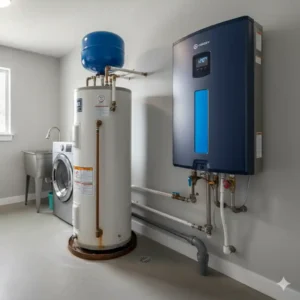
Not all water heaters are built the same, and their lifespans reflect that. Here is what every Northern Colorado homeowner needs to know about each type.
Traditional Tank Water Heaters (Gas & Electric)
Average Lifespan: 8–12 years
The traditional storage tank water heater is the most common type found in Greeley homes. It works by continuously heating and storing a reservoir of water — typically 40 to 80 gallons — so hot water is ready on demand.
Gas tank water heaters tend to have a slightly shorter lifespan than electric models (closer to 8–10 years) but heat water faster and typically cost less to operate. Electric tank models often reach the 10–12 year mark with consistent maintenance.
The single most important component determining your tank’s longevity is the anode rod — a sacrificial metal rod inside the tank designed to attract corrosive minerals before they attack the tank lining itself. When the anode rod is fully depleted and never replaced, the tank walls begin to corrode from the inside out. In Greeley’s hard water environment, anode rod inspections every 3–5 years are not optional; they are essential.
Tankless Water Heaters (On-Demand)
Average Lifespan: 20+ years
Tankless water heaters — also called on-demand water heaters — heat water only when you need it, eliminating the standby heat loss of a storage tank. This fundamental design difference is why they last nearly twice as long as traditional tank units.
Because there is no standing water being constantly heated and cooled, the internal components experience significantly less thermal stress and corrosion over time. A well-maintained tankless unit installed by a licensed plumber in a Greeley home can realistically serve your family for two decades or more.
The critical caveat for Northern Colorado homeowners is scale buildup. Greeley’s hard water is particularly aggressive toward the heat exchanger inside a tankless unit. Annual descaling and flushing is not just recommended — it is the difference between a 20-year investment and a 10-year disappointment. Many manufacturers will void warranties on tankless units that haven’t received documented annual maintenance in hard water areas.
Heat Pump Water Heaters (Hybrid)
Average Lifespan: 10–15 years
Heat pump water heaters — often called hybrid water heaters — are among the most energy-efficient options available to Northern Colorado homeowners today. Rather than generating heat directly, they pull ambient heat from the surrounding air and transfer it to the water, using up to 70% less energy than a traditional electric tank heater.
Their lifespan sits comfortably between tank and tankless units at 10–15 years. They perform best when installed in spaces with consistent ambient temperatures — an unconditioned basement or utility room in a Greeley home is an ideal location. One important consideration: because they extract heat from the air, they are less efficient in very cold spaces, which matters during Colorado’s winter months if your utility room is unheated.
Point-of-Use Water Heaters
Average Lifespan: 7–10 years
Point-of-use water heaters are compact units installed directly at a single fixture — under a bathroom sink or near a kitchen faucet, for example. They are designed to eliminate the lag time between turning on the tap and receiving hot water in larger homes.
Their shorter lifespan of 7–10 years reflects their smaller components and the continuous demand placed on them at a single location. When a point-of-use unit begins to fail, replacement is almost always more cost-effective than repair.
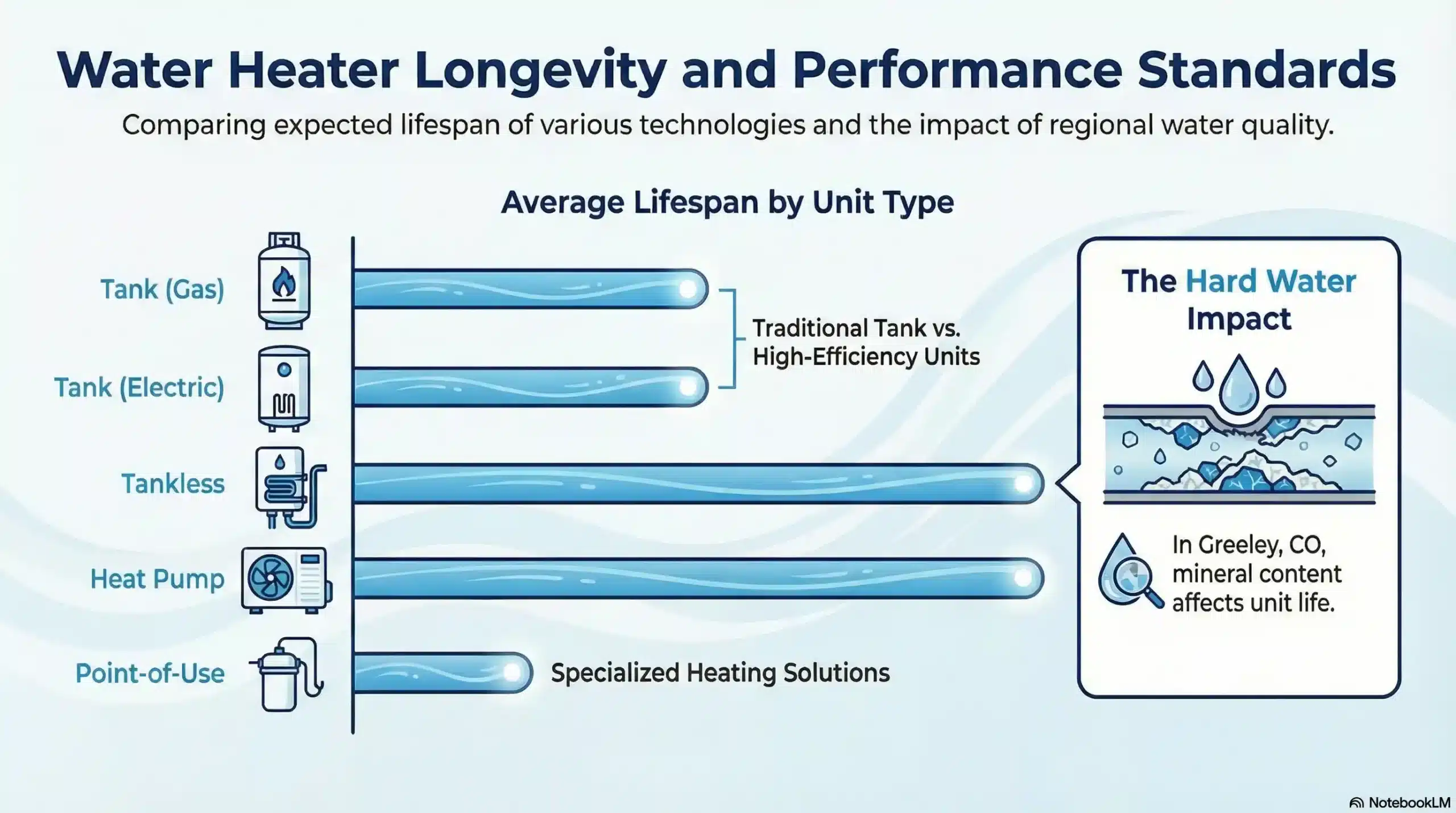
| Water Heater Type | Average Lifespan | Hard Water Impact | Maintenance Frequency |
|---|---|---|---|
| Tank — Gas | 8–10 years | High — accelerates sediment buildup | Annual flush + anode rod check |
| Tank — Electric | 10–12 years | High — accelerates sediment buildup | Annual flush + anode rod check |
| Tankless (On-Demand) | 20+ years | Moderate — scale on heat exchanger | Annual descaling required |
| Heat Pump (Hybrid) | 10–15 years | Low — minimal direct water contact | Bi-annual filter cleaning |
| Point-of-Use | 7–10 years | Moderate | Annual inspection |
7 Warning Signs Your Water Heater Needs to Be Replaced
Knowing your water heater’s age is the starting point. But the unit itself will often tell you when it’s time to go — if you know what to look and listen for. Here are the seven most critical warning signs that every Greeley homeowner should know.
1. Your Unit Is Past Its Expected Lifespan
This is the most overlooked warning sign simply because it requires no symptom at all. If your water heater is 10 years old or older, it is operating in the statistical zone of failure — regardless of whether it seems to be working fine today. Check the manufacturer’s label on the side of your unit. The first four digits of the serial number on most major brands encode the manufacture date. If you cannot read it, a licensed plumber can identify the age instantly.
2. Rusty or Discolored Water
If the hot water coming from your taps is brown, orange, or has a metallic tint, that discoloration is almost certainly originating from inside your tank. It means the interior lining has begun to corrode — and once corrosion takes hold inside a steel tank, replacement is the only lasting solution. Note: if both hot and cold water are discolored, the issue may be with your supply line rather than the water heater itself.
3. Rumbling, Popping, or Banging Noises
That rumbling sound coming from your water heater is sediment — hardened mineral deposits from Greeley’s hard water supply — being tumbled around the bottom of the tank by the heating element. As sediment builds up, it hardens and creates a physical barrier between the burner and the water, forcing the system to work harder and longer to reach temperature. The popping and banging sounds signal that your unit is under significant stress. Annual flushing prevents this entirely; if you’re already hearing it, a professional assessment is overdue.
4. Inconsistent or Insufficient Hot Water
If your shower runs cold after just a few minutes, or you notice significant fluctuations in water temperature throughout the day, your water heater’s heating element or burner is likely failing. In a tank unit, this can sometimes be repaired. But if the unit is already 8 years or older, replacement is almost always the more financially sound decision.
5. Visible Leaks or Moisture Around the Tank
Any pooling water, moisture streaks, or rust staining around the base of your water heater demands immediate professional attention. A slow leak can become a flood with little warning. Some moisture issues stem from loose fittings or a failing pressure relief valve — both repairable. But if the tank itself is leaking from the body, replacement is non-negotiable.
6. Pressure Relief Valve (T&P Valve) Failures
The temperature and pressure relief valve — the T&P valve — is your water heater’s most critical safety device. It is designed to release pressure if the tank overheats, preventing a catastrophic failure. If your T&P valve is leaking, discharging frequently, or has never been tested, this is a serious safety concern that requires immediate professional inspection. A malfunctioning T&P valve on an aging unit is one of the strongest indicators that full replacement should be prioritized.
7. Rapidly Rising Energy Bills
A water heater that is struggling — due to sediment buildup, a failing element, or aging insulation — consumes significantly more energy to deliver the same amount of hot water. If your utility bills have been climbing without a clear explanation, your water heater’s declining efficiency may be a primary contributor. A new high-efficiency unit can deliver meaningful monthly savings that help offset the replacement investment.
🚨 Are You Seeing One of These Warning Signs?
Don’t wait for a cold shower or a flooded utility room to make the call. The team at Top-Notch Plumbing, Heating & Air has served Greeley and Northern Colorado homeowners with honest assessments and expert water heater service.
Call us today at (970) 404-7586
Your comfort and your home’s safety are our priority.
How Northern Colorado’s Hard Water Affects Your Water Heater
Hard water is one of the most significant — and most underestimated — threats to water heater longevity in the Greeley area. The Colorado Rocky Mountain watershed delivers water with elevated levels of dissolved calcium and magnesium. As your water heater heats this water repeatedly, those minerals precipitate out of solution and settle at the bottom of the tank as a hardened sediment layer.
The consequences compound over time. That sediment layer acts as an insulator between the burner and the water, forcing the burner to run longer and hotter to reach the set temperature. This accelerates wear on the heating element, increases your gas or electric bill, and subjects the tank itself to higher thermal stress — leading to premature failure.
Annual tank flushing is the most effective defense. The process drains the tank completely, purging accumulated sediment and restoring the unit’s efficiency. In Greeley’s hard water environment, this should be performed every 12 months without exception — not the every-few-years schedule that national guides (written for average water conditions) often recommend.
The anode rod is your tank’s second line of defense. This magnesium or aluminum rod is suspended inside the tank and sacrifices itself to corrosion so the tank walls don’t have to. In hard water conditions, anode rods deplete faster than manufacturers’ standard timelines. A Top-Notch licensed plumber can inspect and replace your anode rod — a service that can add years to your tank’s life for a fraction of the cost of replacement.
The standard recommended water heater temperature setting of 120°F also plays a role in longevity. Temperatures set significantly higher accelerate mineral precipitation and increase sediment buildup. Keeping your thermostat at 120°F balances safety, efficiency, and longevity for Northern Colorado conditions.
Repair vs. Replace — How to Make the Right Decision
This is the question every Greeley homeowner eventually faces — and the answer is almost never purely about the price of the repair itself. It requires weighing four variables together: age, repair cost, energy efficiency, and risk of future failure.
The industry-standard framework is the 50% Rule: if the estimated repair cost exceeds 50% of the cost of a new replacement unit, replacement is the financially sound decision in virtually every case. Paying $600 to repair a unit that costs $1,200 to replace — and that is already 9 years old — is rarely money well spent.
The decision matrix below helps clarify the right path for most situations:
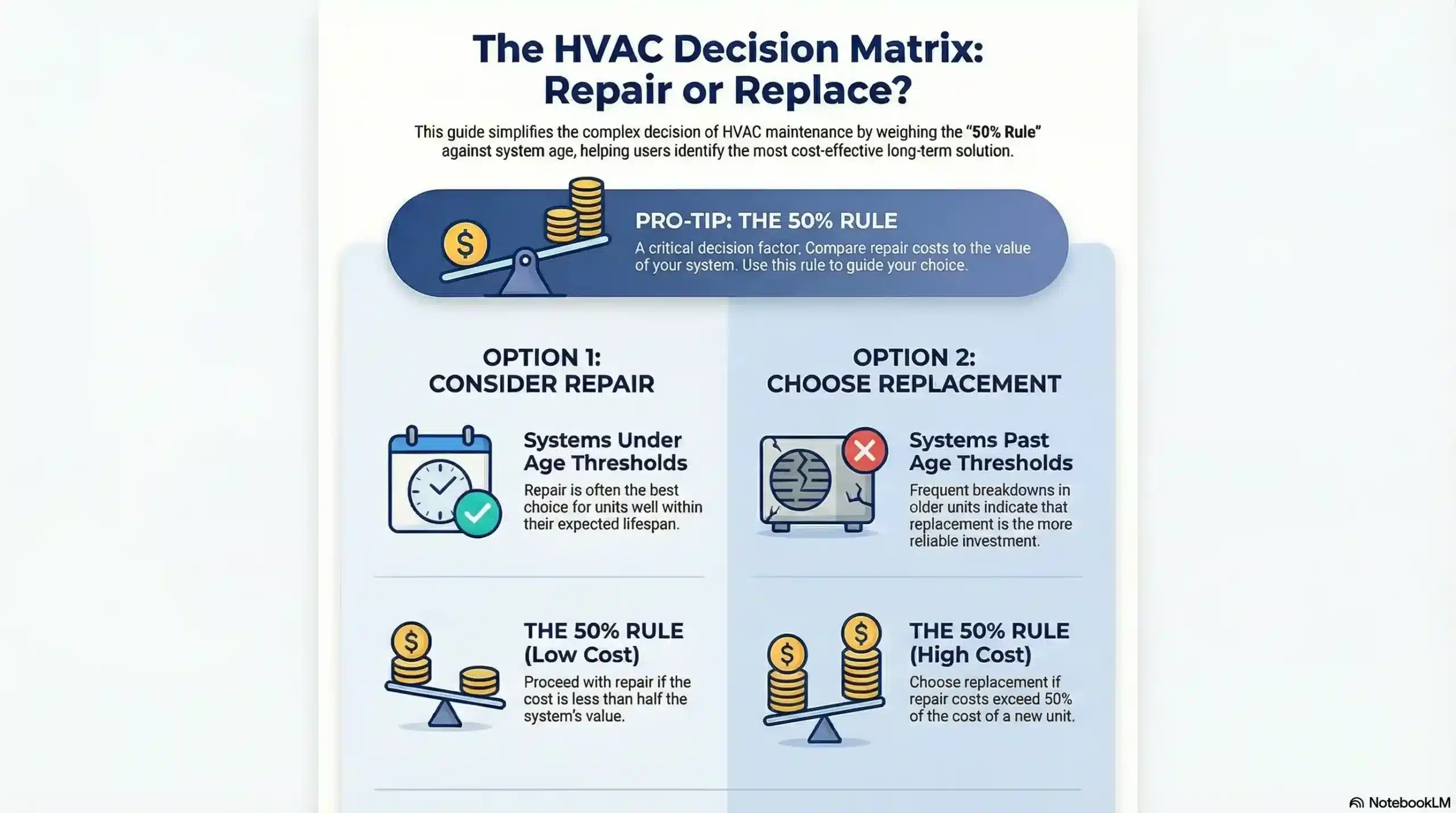
| Scenario | Recommended Action | Reasoning |
|---|---|---|
| Unit under 8 years old, minor repair needed | Repair | Strong remaining lifespan justifies investment |
| Unit 8–10 years old, repair under 50% of replacement cost | Repair with caution | Monitor closely; budget for planned replacement |
| Unit 8–10 years old, repair over 50% of replacement cost | Replace | Poor ROI on aging unit |
| Unit over 10 years old, any significant repair needed | Replace | End of statistical lifespan; replacement protects home |
| Unit actively leaking from tank body | Replace immediately | Tank integrity cannot be restored |
| Unit with repeated failures within 12 months | Replace | Pattern indicates systemic decline |
Financing is available for water heater replacement projects through Top-Notch Plumbing, Heating & Air — making it easier for Greeley homeowners to make the right long-term decision without the pressure of a large upfront cost.
🏆 Get an Honest Assessment from Greeley’s Most Trusted Plumbers
Voted Best of Greeley five consecutive years — 2020, 2021, 2022, 2023, and 2024. Our team of 3 Colorado licensed master plumbers with 60+ years of combined experience will give you a straight answer: repair or replace — and exactly why. We don’t upsell. We help people.
Schedule your water heater evaluation — Call (970) 404-7586
How to Extend the Life of Your Water Heater — Expert Tips from Top-Notch
Even the best water heater benefits from consistent, proactive care. These are the maintenance steps that Top-Notch’s licensed plumbers recommend to every homeowner in Northern Colorado to maximize the return on their water heating investment.
Annual Tank Flushing: Connect a garden hose to the drain valve at the base of the tank, run it to a floor drain or outside, and flush until the water runs clear. In Greeley’s hard water conditions, this should be done every 12 months.
Anode Rod Inspection Every 3–5 Years: This is the most neglected maintenance step and the one that most dramatically extends tank life. If the rod is less than ½ inch thick or heavily coated in calcium, it needs replacement.
Set the Thermostat to 120°F: This temperature eliminates Legionella bacteria risk, reduces scalding danger, slows mineral precipitation, and lowers your energy bill — all at once.
Test the T&P Valve Annually: Lift the lever briefly to ensure it opens and closes freely. If it sticks, weeps continuously, or fails to seat properly, call a licensed plumber immediately.
Insulation Blanket for Older Tank Units: Adding an insulation blanket to a tank water heater that’s more than 7 years old can reduce standby heat loss and lower monthly energy costs while you plan for eventual replacement.
Schedule Annual Professional Maintenance: The most comprehensive protection is a professional annual inspection by a licensed plumber who can assess anode rod condition, check for early corrosion signs, test the T&P valve, and flush the tank — all in a single visit.
🏛️ Local Resources & Citations
1. City of Greeley Utilities — Water Quality Report
Why it helps: Greeley homeowners can check the official annual water quality data here — including hardness and mineral levels — to understand exactly how local water conditions are accelerating sediment buildup in their water heater.
2. Colorado Division of Plumbing — License Verification
Why it helps: Use this official Colorado state portal to verify that your plumber holds a valid, active master plumber license before any water heater repair or replacement work begins in your home.
3. Xcel Energy — Colorado Water Heater Rebates & Efficiency Programs
Why it helps: Greeley homeowners served by Xcel Energy can check here for current rebates and incentives on high-efficiency and heat pump water heater upgrades — reducing the out-of-pocket cost of replacement.
4. U.S. Department of Energy — Water Heater Selection Guide
Why it helps: The official federal resource for comparing water heater types, efficiency ratings, and estimated annual operating costs — giving homeowners unbiased technical specs to guide their repair-or-replace decision.
Why Greeley & Northern Colorado Homeowners Trust Top-Notch Plumbing, Heating & Air
Top-Notch Plumbing, Heating & Air was built from the ground up in Northern Colorado — starting with nothing more than a set of hand tools, a determination to do honest work, and a belief that this trade is fundamentally about helping people. That belief hasn’t changed.
Today, Top-Notch is the most recognized and decorated plumbing team in the Greeley area — trusted not just by homeowners, but by the City of Greeley and Greeley’s ATMOS as an official, vetted service provider.
Here is what sets our team apart:
- ✅ Voted Best of Greeley — 5 consecutive years (2020, 2021, 2022, 2023 & 2024)
- ✅ Five Star Rated — Home Services Review Research Publication (2019–2023)
- ✅ 3 Colorado Licensed Master Plumbers on staff
- ✅ 60+ years of combined team experience
- ✅ 1-year labor warranty on all water heater work
- ✅ 10% First Responder Discount — Firefighters, Paramedics, Police Officers & Flight for Life Pilots
- ✅ Financing available for replacement projects
- ✅ Serving Greeley, Evans, Loveland, and all of Northern Colorado
Owner Adrian Vigil serves as a board member of Partners Northern Colorado, a youth mentorship organization — because Top-Notch’s investment in this community goes far beyond the work we do inside your home.
When you call Top-Notch, you’re not calling a faceless contractor. You’re calling your neighbors — the team that has earned the trust of this community, one honest job at a time.
🤝 Ready to Talk to a Neighbor You Can Trust?
Whether you need an honest second opinion, an annual maintenance visit, or a full water heater replacement, Top-Notch is ready to help.
📞 Call us: (970) 404-7586 📍 Visit us: 3005 W. 29th St. Unit D, Greeley, CO 80631 🕐 Hours: Monday–Friday, 7:00 AM – 4:30 PM
Financing available. First Responder Discount proudly offered.
Frequently Asked Questions
-
The easiest way to find your water heater’s age is to locate the manufacturer’s label on the side of the unit and check the serial number. Most major water heater brands encode the manufacture date in the first four characters of the serial number — typically the first two digits represent the year and the next two represent the week of manufacture. For example, a serial number beginning with “1423” would indicate the unit was manufactured in the 14th week of 2023. If you’re unsure how to read your specific brand’s serial number, a licensed plumber can identify the age of your unit instantly during a service visit. For Greeley homeowners, knowing your water heater’s age is the single most important factor in deciding whether to repair or replace.
Disclaimer:
This content is for informational purposes only and does not replace professional plumbing advice. Water heater lifespan and performance vary based on installation, usage, and local water conditions. Always consult a licensed plumber for an accurate assessment of your system.