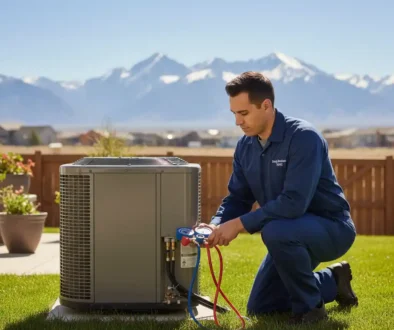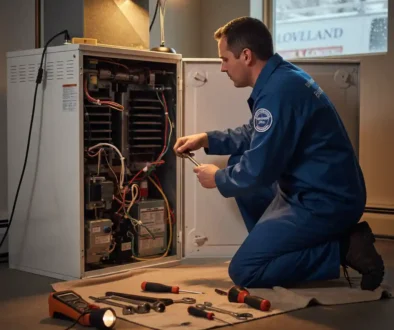
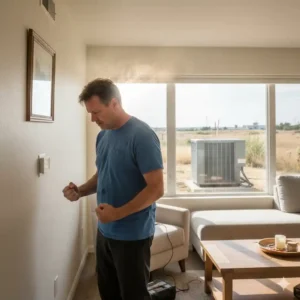
When an air conditioner runs but fails to cool, the most common causes include a clogged air filter, low refrigerant due to a leak, a frozen evaporator coil, a dirty condenser coil, a failing capacitor or contactor, leaking ductwork, or an aging system that has exceeded its service life. Some of these issues are safe for homeowners to check themselves. Others — particularly anything involving refrigerant, electrical components, or internal system diagnostics — require a licensed HVAC technician. For Greeley, CO homeowners, Top-Notch Plumbing, Heating & Air provides expert AC diagnosis and repair backed by five consecutive “Best of Greeley” awards.
When the temperature in Greeley climbs past 95°F and your air conditioner is humming away but pushing nothing but warm air through your vents, the frustration is immediate — and the urgency is real. Colorado’s Front Range summers are not forgiving, and a malfunctioning AC system is more than a comfort problem. For families with young children, elderly members, or anyone with heat sensitivity, it can become a genuine health concern fast.
The good news is that most AC cooling failures come down to one of seven well-understood causes. Some you can address yourself in minutes. Others require a licensed HVAC professional with the right tools and certifications. Knowing the difference protects both your home and your wallet.
At Top-Notch Plumbing, Heating & Air, our HVAC team has been diagnosing and repairing air conditioning systems across Greeley, Evans, Loveland, and all of Northern Colorado for years — earning the trust of our neighbors and the title of “Best of Greeley” for five consecutive years from 2020 through 2024. In this guide, we walk you through exactly what may be causing your AC to underperform and when it is time to make the call.
How Your Home AC System Works
Before diving into what goes wrong, it helps to understand what is supposed to go right. Your central air conditioning system works by continuously cycling refrigerant through a closed loop. The refrigerant absorbs heat from the warm air inside your home at the evaporator coil, carries that heat outside, and releases it through the condenser coil. A blower fan then circulates the now-cooled air back through your ductwork and into your living spaces.
When any single component in this cycle is compromised — whether by wear, blockage, refrigerant loss, or electrical failure — the entire system’s cooling capacity suffers. The result is an AC that runs continuously but delivers little to no relief. Understanding which component has failed is the first step toward fixing it correctly.
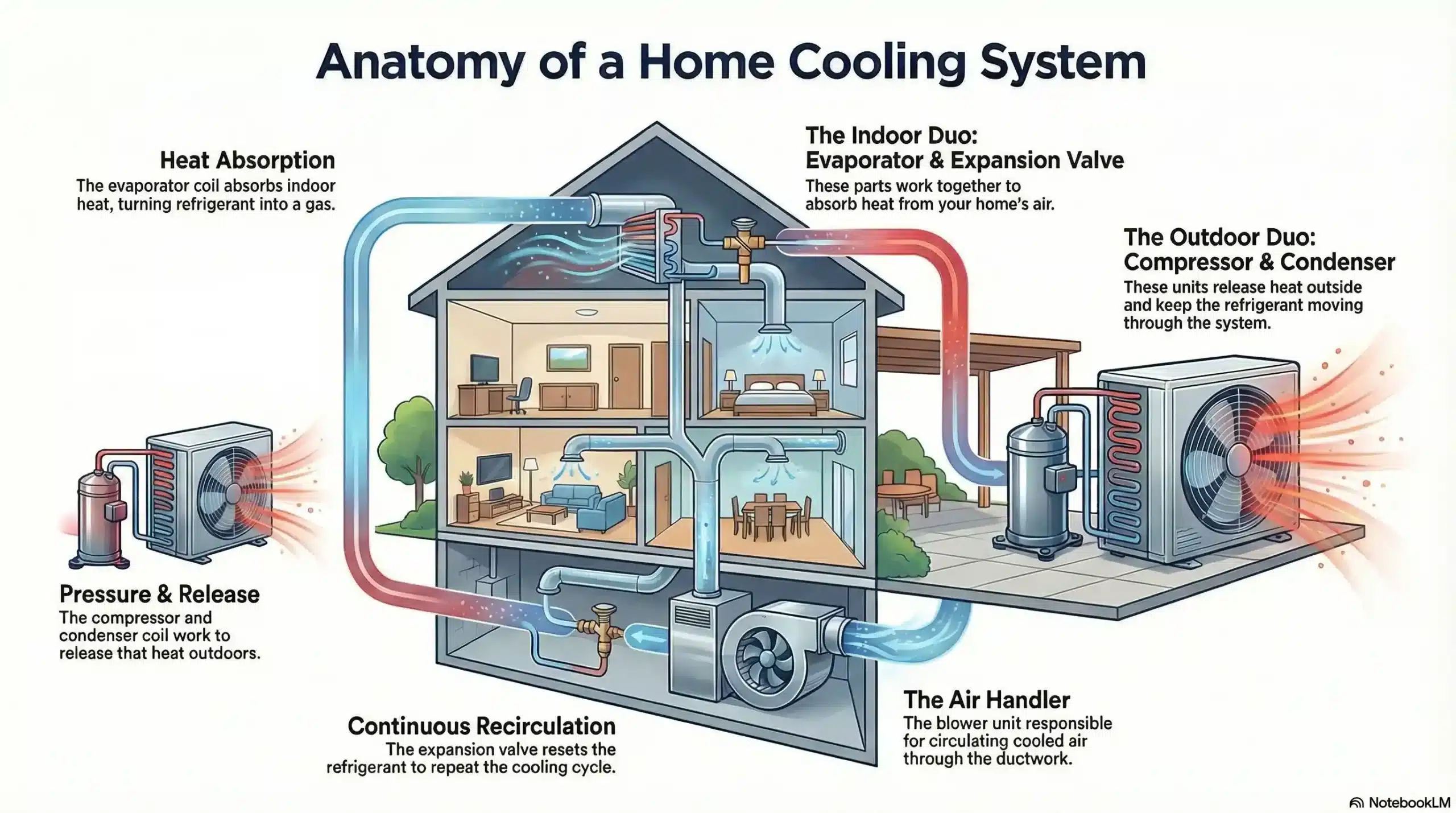
| Component | Function | Failure Impact |
|---|---|---|
| Compressor | Pressurizes refrigerant | No cooling if failed |
| Condenser Coil | Releases heat outside | Overheating, system shutdown |
| Evaporator Coil | Absorbs indoor heat | Freezing, poor airflow |
| Expansion Valve | Regulates refrigerant flow | Uneven or insufficient cooling |
| Air Handler / Blower | Circulates conditioned air | Weak or no airflow indoors |
7 Reasons Your AC Is Running But Not Cooling Your Greeley Home
The following seven causes account for the overwhelming majority of AC cooling failures diagnosed by our technicians throughout Northern Colorado. Each section includes a clear signal on whether this is something you can safely address yourself or whether it requires a professional.
Cause #1: Clogged or Dirty Air Filter
The air filter is the most overlooked — and most impactful — maintenance item in your entire HVAC system. Its job is to trap dust, pollen, pet dander, and debris before air passes through the system. When it becomes clogged, airflow across the evaporator coil drops dramatically. Without adequate airflow, the coil cannot absorb heat effectively, and your home simply stops cooling.
In Greeley and across Weld County, dust accumulation is accelerated by dry conditions and agricultural surroundings, meaning filters can clog faster than the manufacturer’s standard recommendations suggest.
✅ DIY Safe: Check your filter first — every time. Hold it up to a light source. If you cannot see light through it, replace it immediately. Standard 1–3 inch filters should be replaced monthly during peak cooling season. Thicker 4–5 inch filters typically last 6–12 months. This single step resolves a surprising number of calls our technicians receive.
Cause #2: Low Refrigerant / Refrigerant Leak
Refrigerant is the lifeblood of your cooling system. Unlike fuel, refrigerant is not consumed — it circulates in a sealed loop indefinitely. If your system is low on refrigerant, it means there is a leak somewhere in that loop. Adding refrigerant without finding and repairing the leak is not a fix; it is a temporary and costly delay.
Signs of a refrigerant leak include warm air from vents despite the system running, ice forming on the refrigerant lines or evaporator coil, a hissing or bubbling sound near the indoor or outdoor unit, and noticeably higher electricity bills as the system works harder to compensate.
❌ Do Not DIY: Refrigerant handling is federally regulated under EPA Section 608. Only certified HVAC technicians are legally authorized to handle, recover, and recharge refrigerant. Attempting to address this yourself is both a safety risk and a legal violation. Our team at Top-Notch Plumbing, Heating & Air is fully certified to locate the leak, perform the repair, and restore your system to proper refrigerant levels.
📞 Call Top-Notch — Don’t Wait
Refrigerant leaks will not resolve on their own — and every hour your system runs low, it risks permanent compressor damage. Call Top-Notch Plumbing, Heating & Air at (970) 404-7586. Our certified HVAC technicians serve Greeley, Evans, Loveland, and all of Northern Colorado. Located at 3005 W. 29th St. Unit D, Greeley, CO 80631.
Cause #3: Frozen Evaporator Coil
It may seem counterintuitive that an air conditioner can freeze — but a frozen evaporator coil is one of the most common causes of an AC that blows warm or no air. When airflow across the coil is restricted (often from a dirty filter or low refrigerant), the coil temperature drops below freezing and ice begins to form. That ice layer acts as an insulator, blocking the coil from absorbing any heat at all.
You may notice ice visible on the refrigerant lines near the indoor unit, reduced or completely absent airflow from your vents, or water dripping around the air handler as the ice melts.
⚠️ Partial DIY: If you suspect a frozen coil, turn your system off immediately and switch the fan to “ON” (not “AUTO”) to begin thawing. Do not attempt to chip or scrape the ice. Allow 2–4 hours for a full thaw. However — and this is critical — a frozen coil is a symptom, not the root cause. Once thawed, the underlying issue (restricted airflow or refrigerant loss) must be professionally diagnosed to prevent recurrence.
Cause #4: Dirty or Blocked Condenser Coil
Your outdoor condenser unit has one primary job: release the heat your system pulled from inside your home out into the outside air. To do this, the condenser coil must have clear airflow around it. When the coil becomes coated in dirt, grass clippings, cottonwood fluff — which is particularly prevalent along the Front Range every spring — or debris from Colorado’s frequent hailstorms, it loses its ability to dissipate heat. The result is a system that struggles to cool and may overheat and shut down entirely.
⚠️ Partial DIY: You can safely clear debris from around the outdoor unit and gently rinse the exterior fins with a garden hose on a low setting. However, deep coil cleaning using chemical coil cleaner, and straightening bent condenser fins, should be handled by a technician to avoid damaging the delicate coil fins or the refrigerant lines.
Cause #5: Failing Capacitor or Contactor
Inside your outdoor unit sit two small but critical electrical components: the capacitor and the contactor. The capacitor provides the jolt of electricity needed to start the compressor and fan motors. The contactor is a relay switch that controls when power flows to the unit. When either of these components begins to fail, your system may hum loudly but fail to start, short-cycle on and off, or run continuously without cooling.
These are among the most common electrical failures in AC systems — particularly in systems that are five or more years old — and they tend to accelerate in failure during periods of extreme heat demand, exactly when you need your system most.
❌ Do Not DIY: Capacitors store an electrical charge even when power to the unit is disconnected and can deliver a potentially lethal shock. This repair requires a licensed HVAC technician with proper discharge tools and safety protocols. If your outdoor unit is humming but the fan is not spinning, or the system clicks on and off rapidly, shut it down and call a professional immediately.
Cause #6: Leaking or Poorly Sealed Ductwork
Your ductwork is the delivery network for every cubic foot of cooled air your system produces. When ducts develop leaks — through age, poor original installation, or physical damage — a significant portion of that conditioned air escapes into unconditioned spaces like attics, crawl spaces, and wall cavities before it ever reaches your living areas. Studies from the U.S. Department of Energy indicate that the average home loses a meaningful amount of conditioned air through duct leaks, resulting in higher energy bills and rooms that never quite reach the set temperature.
In older Greeley homes, ductwork may have been installed with materials or connection methods that degrade over time, making this a particularly relevant concern for the local housing stock.
❌ Do Not DIY: Duct leakage diagnosis requires either a professional duct pressure test or thermal imaging. Sealing is performed with approved mastic sealant or metal-backed tape — not standard household duct tape, which fails quickly under temperature cycling. This is a professional service.
Cause #7: Aging or Undersized AC System
A well-maintained central air conditioning system in Colorado typically has a service life of 15 to 20 years. As a system approaches and surpasses this range, its efficiency degrades progressively. The compressor works harder, energy consumption climbs, and the system increasingly struggles to maintain set temperatures during peak afternoon heat — even when no single component has failed outright.
An undersized system presents a similar challenge: a unit that was never properly sized for your home’s square footage, insulation level, or sun exposure will run continuously without ever achieving the thermostat’s target temperature.
If your system is more than 12–15 years old, requires frequent repairs, runs non-stop on hot days, or was installed without a professional load calculation, it may be time for an honest conversation about repair versus replacement. A newer high-efficiency system can deliver dramatically better comfort at a significantly lower operating cost.
❌ Schedule a Professional Assessment: Our team can perform a thorough evaluation of your current system’s condition and capacity and present you with clear, honest options — whether that is a targeted repair, a system tune-up, or a replacement recommendation that fits your home and your budget.
DIY vs. Call a Professional: A Greeley Homeowner’s Quick Reference
Not every AC problem requires a service call. Use this table to quickly assess your situation and determine the right next step for your home.
| Issue | DIY Safe? | Recommended Action |
|---|---|---|
| Dirty or clogged air filter | ✅ Yes | Replace filter immediately |
| Incorrect thermostat settings | ✅ Yes | Check settings; replace batteries |
| Tripped circuit breaker | ✅ Yes | Reset once — if it trips again, call a pro |
| Debris around outdoor unit | ✅ Yes | Clear vegetation; gentle hose rinse |
| Frozen evaporator coil | ⚠️ Partial | Turn off AC; allow full thaw; call pro for root cause |
| Dirty condenser coil (deep) | ⚠️ Partial | Surface rinse OK; chemical cleaning requires pro |
| Refrigerant leak | ❌ No | Call licensed HVAC technician immediately |
| Capacitor or contactor failure | ❌ No | Electrical hazard — do not attempt; call technician |
| Ductwork leaks | ❌ No | Requires professional pressure testing and sealing |
| System over 12–15 years old | ❌ No | Schedule a professional system assessment |
📞 Your Trusted Greeley HVAC Team
Not sure where your AC problem falls on this list? Our team at Top-Notch Plumbing, Heating & Air has been the trusted HVAC partner for Greeley homeowners for years — voted Best of Greeley five consecutive years (2020–2024). We will diagnose your system honestly and give you clear options, never pressure. Call us at (970) 404-7586 or stop by 3005 W. 29th St. Unit D, Greeley, CO 80631. Financing is available for qualifying projects.
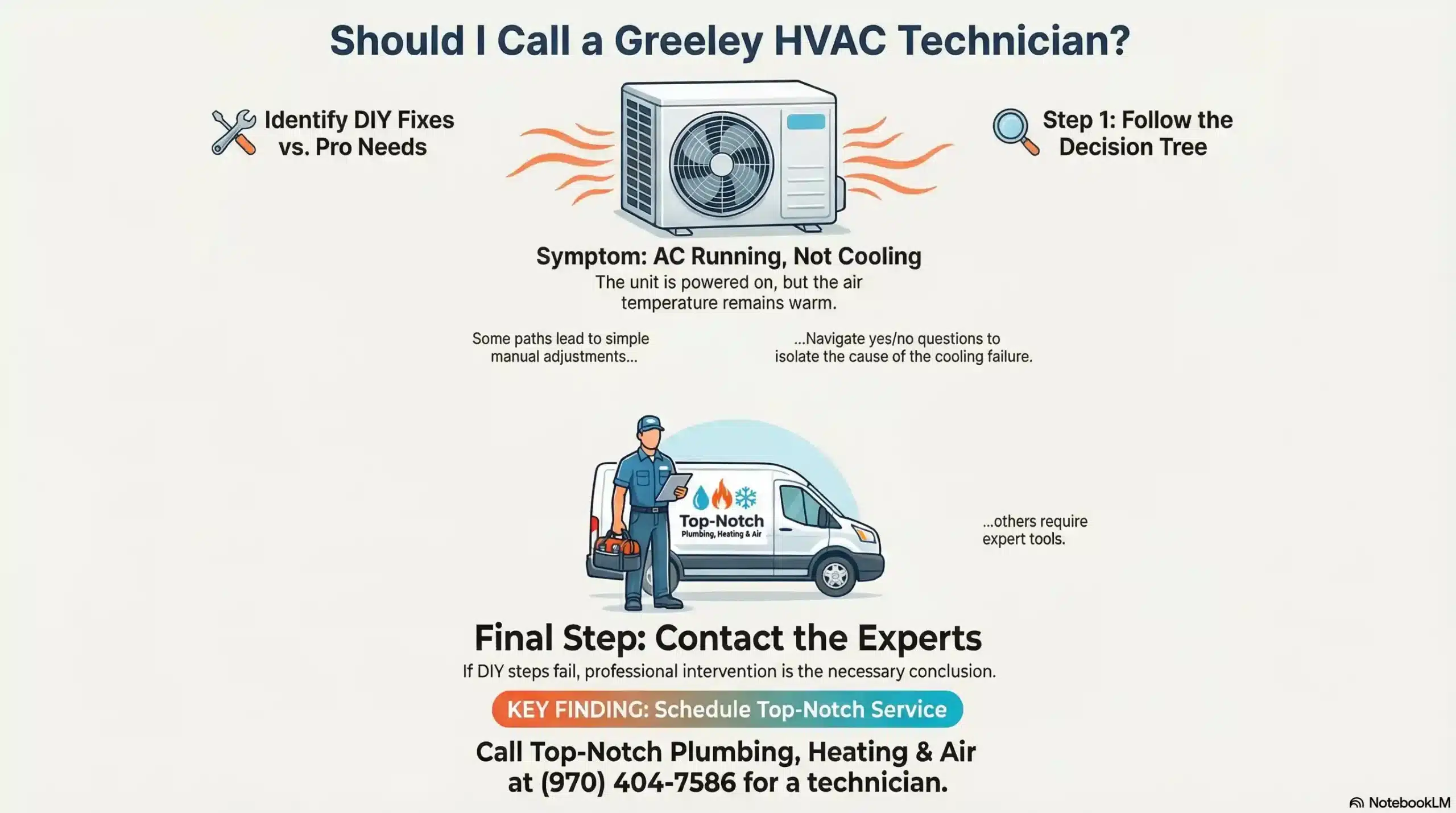
| Symptom | First Check | Next Step |
|---|---|---|
| Warm air blowing from vents | Check air filter and thermostat | If unchanged after filter replace → Call Top-Notch |
| Ice visible on refrigerant lines | Turn off AC system immediately | Call Top-Notch — do not delay |
| Outdoor unit humming, not starting | Check circuit breaker | If breaker trips again → Call Top-Notch |
| Weak airflow from all vents | Check and replace air filter | If airflow unchanged → Call Top-Notch |
| Hissing or bubbling sounds | Do not ignore | Call Top-Notch immediately |
| System runs non-stop, no cooling | Check filter and thermostat | If system is 10+ years old → Call Top-Notch |
Why Greeley Homeowners Trust Top-Notch Plumbing, Heating & Air
When your home’s comfort system fails on the hottest day of a Colorado summer, you need more than a technician — you need a team you already trust. That is exactly what Top-Notch Plumbing, Heating & Air has spent years building in Greeley and across Northern Colorado.
Our HVAC services are led by Andrew, a licensed residential plumber and Leonardi HVAC-certified technician who brings a hands-on legacy of trade knowledge developed alongside his father, a master plumber with over 20 years of experience. He leads a team that collectively brings over 60 years of combined industry experience to every service call.
Our commitment to quality is backed by a 1-year warranty on all labor — because we stand behind our work completely. We are a trusted service vendor for the City of Greeley and Greeley’s ATMOS, hold a Trustindex verified badge reflecting a consistent 4.5-plus customer review score, and have been named to the Five Star Rated publication by Home Services Review Research from 2019 through 2023.
We are also proud to serve those who serve our community. Local heroes — Firefighters, Paramedics, Police Officers, and Flight for Life Pilots — receive an exclusive 10% First Responders Discount as our way of saying thank you.
And because we are a grassroots Greeley small business — not a regional chain — every dollar you invest in your home stays in this community. Owner Adrian Vigil serves on the board of Partners Northern Colorado, an organization dedicated to youth mentorship, because investing in people has always been at the heart of what this company does.
One customer described their experience with our team as seamless from the first phone call to the final repair — with every step of the process clearly explained and every option honestly presented. That is not a sales approach. That is simply how we believe neighbors should treat neighbors.
Local Resources & Citations
1. City of Greeley — Building & Permits Division Check here to verify whether your AC repair or replacement requires a city permit — Greeley requires permits for most HVAC system installations and replacements, and hiring a licensed contractor like Top-Notch ensures full compliance.
2. Xcel Energy — Colorado Home Energy Efficiency Rebates Visit here to explore available rebates on qualifying high-efficiency AC and HVAC system upgrades — Greeley homeowners served by Xcel Energy may be eligible for significant savings when replacing an aging system.
3. Colorado Department of Regulatory Agencies (DORA) — License Verification Use this official state portal to verify that any HVAC contractor you hire — including confirming Top-Notch Plumbing, Heating & Air’s Master Plumber License MP00600505 — holds a valid, active Colorado license before work begins.
4. U.S. Department of Energy — Air Conditioning Energy Efficiency Guide Reference this federal resource for unbiased guidance on AC system efficiency ratings (SEER), proper sizing, and maintenance best practices to help Greeley homeowners make informed repair-or-replace decisions.
Protecting Your Home: Preventative AC Maintenance Tips for Northern Colorado
The best AC repair is the one you never need. A small investment in routine maintenance each year pays significant dividends in system longevity, energy efficiency, and avoided emergency repairs — particularly in Colorado’s demanding climate.
Here are the key maintenance steps every Greeley homeowner should follow:
Change your air filter on schedule. During peak cooling season, check your filter monthly. Greeley’s dry, dusty conditions mean filters can reach capacity faster than standard guidance suggests.
Schedule a professional pre-season tune-up. Before the summer heat sets in — ideally in April or May — have a licensed technician inspect your refrigerant levels, clean your coils, test electrical components, and verify system performance. Catching a failing capacitor in May costs a fraction of an emergency repair in July.
Keep your outdoor unit clear. After Greeley’s cottonwood season and following any hailstorm, inspect your condenser unit for debris accumulation or fin damage. Maintain at least two feet of clearance around all sides of the unit.
Listen to your system. New sounds — hissing, clicking, banging, or grinding — are your system communicating that something has changed. Do not ignore them. Early diagnosis prevents minor issues from becoming major failures.
Have your ductwork inspected every few years. Particularly in older Greeley homes, duct integrity degrades over time. A professional inspection can identify leaks that are silently inflating your energy bill every month.
A well-maintained system serves your family reliably for 15 to 20 years. Our team at Top-Notch Plumbing, Heating & Air is proud to be the annual maintenance partner for hundreds of Northern Colorado homeowners — and we would be honored to add your home to that list.
📞 Don’t Let the Greeley Summer Heat Win
Whether you need an emergency diagnostic, a targeted repair, or a full system assessment, Top-Notch Plumbing, Heating & Air is your trusted local HVAC team — your neighbors, your experts, your advocates. Call us today at (970) 404-7586. We are located at 3005 W. 29th St. Unit D, Greeley, CO 80631. Open Monday through Friday, 7:00 AM to 4:30 PM. Financing available for qualifying projects.
Frequently Asked Questions
-
When an air conditioner runs continuously but fails to cool your home, the most common causes are a clogged air filter restricting airflow, low refrigerant due to a leak in the system, a frozen evaporator coil, or a failing electrical component such as a capacitor. In some cases, aging equipment or an undersized system may also be the cause. Start by checking and replacing your air filter. If that does not resolve the issue, contact a licensed HVAC technician for a full diagnostic. Greeley homeowners can reach Top-Notch Plumbing, Heating & Air at (970) 404-7586 for professional AC diagnosis and repair.