Signs Your Water Line Is Too Shallow (and What It Means)
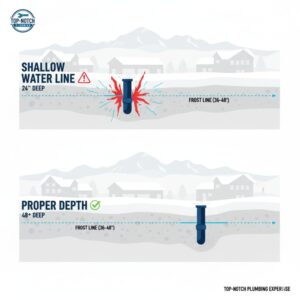
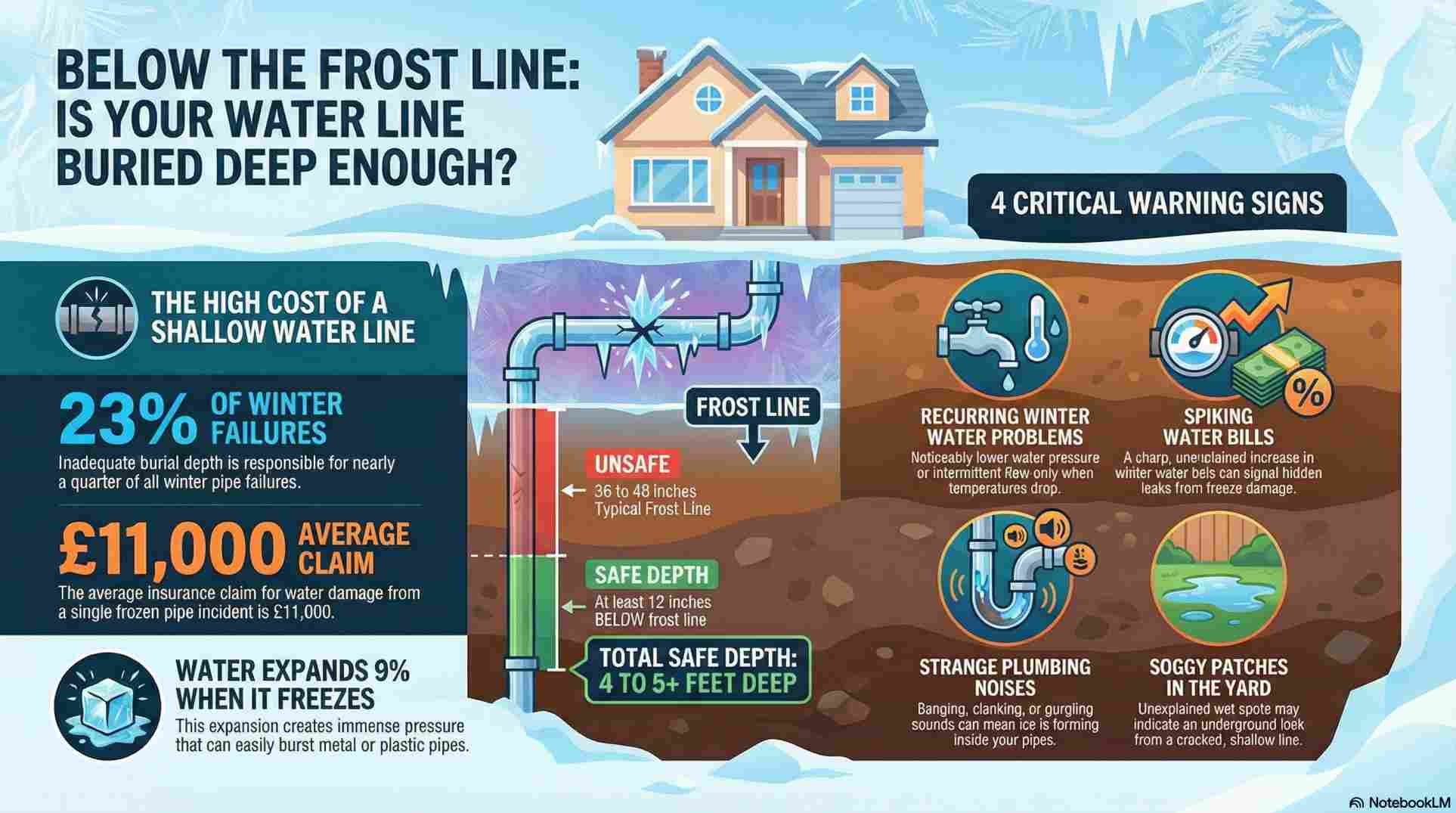
To prevent frozen pipes, water lines in Northern Colorado must be buried at least 4 to 5 feet deep to sit 12 inches below the local frost line. If your water flow drops or your winter bills spike, your line may be buried too shallow, putting you at risk for a catastrophic pipe burst averaging $13,954 in damages.
[Get a Professional Water Line Depth Assessment]
The Science Behind Shallow Water Line Problems
Water expands approximately 9% when it freezes, creating tremendous internal pressure within pipes. A 2024 Utah State University study analyzing over 400,000 miles of water lines found that improperly buried lines account for 23% of winter pipe failures in cold climate regions. When water lines are buried too shallow, three critical problems occur:
- Ice Formation: Water inside the pipe freezes solid, blocking flow completely
- Pipe Expansion: The expanding ice creates internal pressure exceeding most pipes’ burst strength
- Structural Damage: Repeated freeze-thaw cycles weaken pipe walls, leading to premature failure
The financial impact is substantial. According to 2025 insurance industry data, water damage claims from frozen pipes average $13,954 per incident, with full water line replacements ranging from $3,000 to over $10,000 depending on depth and excavation requirements.
7 Critical Warning Signs Your Water Line Is Too Shallow
1. Recurring Winter Water Flow Problems
What to Watch For:
- Reduced water pressure during cold snaps
- Intermittent water flow that stops and starts
- Complete loss of water during sustained freezing temperatures
- Water flow that only returns when temperatures rise above freezing
What This Means: These symptoms indicate that your water line is experiencing partial or complete freezing. If this occurs repeatedly during normal Colorado winter conditions (temperatures between 10-25°F), your line is almost certainly buried too shallow. The recurring nature of these problems suggests the line sits within or just below the frost zone, making it vulnerable to frozen water lines whenever temperatures drop.
Immediate Action Required: Contact a licensed plumber immediately if you experience these symptoms. Continued freezing cycles will weaken your pipes and ultimately lead to catastrophic failure.
2. Visible Frost or Ice on Exposed Pipe Sections
What to Watch For:
- Frost formation on any visible portions of your water line
- Ice buildup around pipe entries into your home
- Condensation or moisture on exterior pipe sections during cold weather
- White, crystalline deposits on pipe surfaces
What This Means: Visible frost on pipes is a clear indicator that freezing conditions are reaching your water line. This typically occurs when lines are buried less than 24 inches deep—well above safe depths for Northern Colorado conditions. The presence of surface frost signals that underground portions are also at risk.
Expert Insight from Top-Notch Plumbing: “When we see frost on any part of a customer’s water line system, we know immediately that the burial depth is insufficient,” explains Roland, a licensed service plumber with over eight years of experience at Top-Notch Plumbing. “This is often our first clue during winter service calls in Greeley and Evans. We’ve been voted Best of Greeley for five consecutive years because we catch these warning signs early and prevent major damage.”
3. Unusually High Water Bills Without Apparent Cause
What to Watch For:
- Water bills that spike 20-40% during the winter months
- Unexplained water usage when household habits haven’t changed
- Bills that remain high even when reducing water consumption
- Municipal notices about unusual water meter activity
What This Means: Shallow water lines often develop small cracks and leaks due to repeated freeze-thaw stress. These micro-leaks may not be immediately visible, but can waste hundreds of gallons monthly. A sudden increase in water usage during winter often indicates that freeze damage has compromised your line’s integrity.
Economic Impact: According to 2024 data from water utilities across Northern Colorado, customers with shallow water lines report average winter bill increases of $150-300 per month due to leak-related waste.
4. Strange Noises from Your Plumbing System
What to Watch For:
- Banging or clanking sounds when turning on faucets
- Whistling noises from water lines during cold weather
- Gurgling sounds from pipes, especially during temperature fluctuations
- Vibrations in pipes that weren’t present during warmer months
What This Means: These noises typically indicate that ice is forming within or moving through your water lines. As ice expands and contracts with temperature changes, it creates turbulence and pressure variations that manifest as unusual sounds. This is often an early warning sign before complete line failure.
5. Inconsistent Water Temperature
What to Watch For:
- Water that runs extremely cold, even after running for several minutes
- Temperature fluctuations that seem related to outside air temperature
- Hot water that never reaches normal temperatures during cold snaps
- Mixing of hot and cold water that creates lukewarm results
What This Means: Shallow water lines are influenced by ground temperature variations that don’t affect properly buried lines. When your supply line runs too close to the surface, cold ground temperatures directly cool the water before it reaches your home, overwhelming your water heater’s capacity and creating persistent temperature problems.
6. Wet Spots or Unusual Vegetation Growth
What to Watch For:
- Unexplained wet or soggy areas in your yard during winter
- Patches of grass that remain green when the surrounding areas are dormant
- Areas of abnormal vegetation growth along your suspected water line path
- Depressions or soft spots in the ground above your water line
What This Means: These signs often indicate underground leaks caused by freeze damage to shallow water lines. Escaping water creates moisture patterns visible at the surface and can cause vegetation changes due to extra water and nutrients. During winter, these signs are particularly telling since normal irrigation and precipitation are minimal.
7. Previous Freeze-Related Repairs
What to Watch For:
- History of frozen pipe repairs in your home
- Documentation of water line work performed during the winter months
- Multiple service calls for winter plumbing problems
- Repairs that seem to be temporary solutions rather than permanent fixes
What This Means: A pattern of winter plumbing problems strongly suggests inadequate burial depth. Many homeowners experience repeated issues because temporary repairs don’t address the root cause—insufficient depth protection from freezing temperatures.
Understanding the Regional Context: Northern Colorado’s Frozen Water Lines Risk
Frost Line Variations Across Our Service Area
Different areas within Northern Colorado experience varying frost line depths:
- Greeley Area: 36-42 inches typical depth
- Fort Collins: 38-44 inches, increasing with elevation
- Evans: 36-40 inches in residential areas
- Loveland: 40-46 inches due to foothills proximity
- Mountain Communities: Up to 60+ inches at higher elevations
Soil Composition Impact
Northern Colorado’s diverse soil conditions significantly affect freeze patterns:
Clay Soils (common in Greeley and Evans):
- Retain moisture, increasing freeze risk
- Expand when frozen, creating additional pipe stress
- Require deeper burial for equivalent protection
Sandy Soils (found in parts of Fort Collins):
- Drain well, but provide less thermal mass
- Allow deeper frost penetration
- May require burial depths 6-12 inches deeper than clay areas
Rocky Soils (mountainous areas):
- Create uneven freezing patterns
- May allow frost penetration along rock interfaces
- Often require specialized installation techniques
Climate Change Considerations for 2025 and Beyond
Recent weather data shows that traditional frost line calculations may need updates due to climate variability. The 2024-2025 winter season has already produced temperature extremes and unpredictable weather patterns that differ from historical averages, creating challenges for standard depth calculations.
While overall warming trends may reduce average frost penetration depth, extreme cold events can still occur unpredictably. Top-Notch Plumbing now recommends burial depths of 18-24 inches below traditional frost lines to account for these weather uncertainties and provide long-term reliability regardless of climate variations.
The Real Cost of Shallow-Buried Water Lines
Emergency Repair Costs (2025 Data)
Based on current Northern Colorado pricing, shallow water line problems create substantial financial impacts:
Immediate Emergency Response:
- Service call during winter emergency: $200-400
- Temporary line thawing: $500-1,200
- Emergency water restoration: $600-1,600
Permanent Solutions:
- Partial line replacement (50-100 feet): $2,500-6,000
- Complete line replacement with proper depth: $4,000-12,000
- Excavation in frozen ground: Additional $1,200-2,500
- Landscape restoration: $600-2,000
Insurance and Code Compliance Issues
Insurance Complications: Recent changes in homeowners’ insurance policies have made frozen pipe claims more complex. Many insurers now investigate whether proper installation codes were followed. Claims for damage from improperly buried water lines may be denied or result in higher premiums.
Expert Insight from Top-Notch Plumbing: “We’ve seen too many homeowners devastated by insurance claim denials because their water lines weren’t buried to code,” notes Miguel, a licensed service plumber born and raised in Greeley. “As a local business that’s been serving this community with excellence for years, we always ensure our installations meet or exceed code requirements. It protects our neighbors from both freeze damage and insurance complications.”
Code Violations: Shallow water lines violate International Plumbing Code requirements and local Northern Colorado building codes. During home sales or major renovations, these violations can:
- Delay closing procedures
- Require immediate correction before sale completion
- Result in municipal fines ranging from $200-1,000
- Affect property valuation and financing approval
Scientific Evidence: Recent Studies on Frozen Water Lines
Study #1: Utah State University Water Main Break Analysis (2024)
A comprehensive study published in February 2024 analyzed over 400,000 miles of water lines across the United States and Canada. Key findings relevant to shallow water line issues:
- 23% of winter failures are attributed to inadequate burial depth
- $2.6 billion annual repair costs from preventable depth-related failures
- 53-year average life span for properly buried lines vs. 31 years for shallow installations
Source: Barfuss, S.L., et al. “Water Main Break Rates in the USA and Canada: A Comprehensive Study.” Utah Water Research Laboratory, 2024.
Study #2: Insurance Industry Water Damage Report (2025)
According to the Insurance Information Institute’s 2025 analysis of homeowners’ claims data, problems with shallow-buried water line installations revealed significant patterns in freeze-related damage:
- 28% of all home insurance claims involve water damage and freezing
- Peak claim months: January-February, correlating with sustained freezing periods
- Average claim severity: $13,954 per incident
- Claims frequency: 1.6% of insured homes file water damage claims annually
Source: Insurance Information Institute. “Home Water Damage Statistics 2025.” September 2025.
Study #3: Climate Impact on Frost Penetration (2024)
Research published in Applied Sciences and multiple climate engineering journals analyzed how changing climate patterns affect traditional frost line calculations:
- Shallower frost penetration in most regions due to warming temperatures
- Variable freeze-thaw cycles create unpredictable stress patterns on shallow lines
- Updated building codes are needed to account for changing climate conditions while maintaining safety margins
Source: Multiple 2024 studies, including Applied Sciences, Journal of Geophysical Research, and infrastructure engineering publications, analyzing climate change impacts on frost depth.
Professional Solutions: What Top-Notch Plumbing Recommends
Immediate Assessment Protocol
When we suspect a shallow water line, our certified team follows a systematic evaluation process:
- Visual Inspection: Examining accessible pipe sections for freeze damage
- Flow Testing: Measuring pressure and flow rates under various temperature conditions
- Thermal Imaging: Using infrared cameras to identify heat loss patterns
- Excavation Analysis: Strategic digging to verify actual burial depth
- Soil Assessment: Evaluating local soil conditions and frost risk factors
Long-term Solutions
Option 1: Complete Line Replacement with Proper Depth
- Excavation to 5-6 feet depth (Northern Colorado standard)
- Installation of new frost-resistant piping
- Proper backfilling with appropriate materials
- Timeline: 2-3 days for typical residential installation
- Cost Range: $5,000-12,000, depending on distance and conditions
Option 2: Enhanced Insulation Systems
- Installation of rigid foam insulation around existing shallow lines
- Heat trace cable installation for extreme weather protection
- Waterproof barriers to prevent insulation degradation
- Timeline: 1-2 days for typical installation
- Cost Range: $2,000-5,000, depending on line length
Option 3: Bypass Installation
- Installing a new properly buried line while maintaining the existing service
- Gradual transition during favorable weather conditions
- Minimal service disruption during installation
- Timeline: 3-4 days with planning coordination
- Cost Range: $6,000-15,000 for complex installations
Seasonal Preparation Strategies
Fall Preparation (September-November):
- Professional line inspection and depth verification
- Insulation installation or upgrades to prevent frozen water lines
- Shut-off valve accessibility improvement
- Emergency contact information updates
Winter Monitoring (December-March):
- Regular temperature monitoring
- Drip protocol during extreme cold
- Quick response to flow reduction signs
- Emergency service preparation
Spring Assessment (April-May):
- Post-winter damage evaluation
- Leak detection and repair
- Long-term improvement planning
- Insurance documentation updates
Preventive Measures: Protecting Your Investment from Frozen Water Lines
Homeowner Action Steps
Immediate Winter Protection:
- Monitor Weather Forecasts: Prepare for sustained temperatures below 20°F
- Maintain Basement Heat: Keep areas above 40°F where possible
- Implement Drip Protocol: Allow small water flow during extreme cold
- Insulate Exposed Areas: Wrap any visible pipe sections
- Know Your Shutoffs: Locate and test main water shut-off valves
Long-term Planning:
- Document Current Depth: Have professional verification of burial depth
- Plan Summer Projects: Schedule depth corrections during favorable weather
- Upgrade Materials: Consider freeze-resistant piping materials during renovations
- Improve Drainage: Ensure water doesn’t pool near your water line path
- Regular Inspections: Annual professional assessment of your water line system
Technology Solutions
Smart Monitoring Systems:
- Leak Detection Sensors: WiFi-enabled devices that monitor for water leaks
- Temperature Monitoring: Ground temperature sensors for freeze prediction
- Pressure Monitoring: Systems that alert to pressure drops indicating freezing
- Flow Sensors: Devices that detect unusual water usage patterns
Advanced Protection Options:
- Heat Trace Systems: Self-regulating cables that prevent freezing
- Smart Shut-offs: Automatic valves that close during leak detection
- Remote Monitoring: Professional monitoring services for high-risk properties
When to Call a Professional: Emergency vs. Routine Service
Emergency Situations Requiring Immediate Professional Response
Call Top-Notch Plumbing immediately if you experience:
- Complete loss of water flow during freezing weather
- Visible water leaks or wet spots during winter
- Strange noises or pressure fluctuations indicating frozen water lines
- Water that won’t reach normal temperature after extended running
- Signs of structural damage to exposed pipes
Emergency Contact Information:
- 24/7 Emergency Service: (970) 404-7586
- Address: 3005 W. 29th St. Unit D, Greeley, CO 80631
- Service Area: Greeley, Evans, Fort Collins, Loveland, and all of Northern Colorado
Routine Assessment and Planning Services
Schedule a professional assessment during:
- Annual home maintenance planning (spring/fall)
- Home purchase or sale preparations
- Major renovation planning
- Insurance policy reviews
- Recurring winter plumbing problems
Regional Code Requirements and Compliance
Northern Colorado Building Codes
Current International Plumbing Code (IPC) requirements adopted by local municipalities:
Minimum Depth Requirements:
- Greeley: 12 inches below frost line (minimum 48 inches total depth)
- Fort Collins: 12 inches below frost line (minimum 50 inches total depth)
- Evans: 12 inches below frost line (minimum 48 inches total depth)
- Loveland: 12 inches below frost line (minimum 52 inches total depth)
Additional Requirements:
- Professional installation and inspection
- Proper materials certification
- Backfill specifications compliance
- Documentation for building permits
Permit and Inspection Process
When Permits Are Required:
- New water line installations
- Complete line replacements
- Depth modifications exceeding 50 feet
- Connections to municipal systems
Inspection Timeline:
- Initial excavation approval
- Installation inspection before backfill
- Final system testing and approval
- Certificate of compliance issuance
Choosing the Right Professional: Why Experience Matters
Top-Notch Plumbing’s Advantages
Credentials and Experience:
- 3 Licensed Master Plumbers (License MP00600505)
- 60+ years of combined experience in Northern Colorado conditions
- Contractor License PC0003639 for all municipal jurisdictions
- 5-year consecutive “Best of Greeley” winner (2020-2024)
Local Expertise:
- Deep regional knowledge of frost patterns and soil conditions
- Established relationships with local building departments
- Weather-specific protocols for the Northern Colorado climate
- Comprehensive understanding of municipal water systems
Quality Guarantees:
- 1-year warranty on all labor and installations
- 24/7 emergency response during the winter months
- Up-front pricing with no hidden fees
- Licensed, insured, and bonded for your protection
Questions to Ask Any Plumbing Contractor
Before hiring anyone for water line work, verify:
- “Are you licensed as a master plumber in Colorado?”
- “How many shallow water line corrections have you completed in Northern Colorado?”
- “Do you provide warranties on excavation and installation work?”
- “Can you provide references from recent winter emergency calls?”
- “Do you carry specific insurance for excavation work?”
Sources and References
The information in this article is based on current research, industry studies, and authoritative sources to ensure accuracy and reliability for Northern Colorado homeowners.
- Utah State University Water Research Laboratory (2024)
“Water Main Break Rates in the USA and Canada: A Comprehensive Study”
This comprehensive study analyzed 400,000+ miles of water infrastructure data across the US and Canada, providing critical statistics on water main failures, break rates, and repair costs that inform our understanding of shallow water line risks. - Insurance Information Institute (2025)
“Facts + Statistics: Homeowners and Renters Insurance.”
Current insurance industry data shows water damage claim frequencies, average costs ($13,954 per claim), and patterns that demonstrate the financial impact of frozen water line failures on homeowners. - International Code Council – International Plumbing Code
“2024 International Plumbing Code (IPC)”
Official plumbing code requirements for water line installation depths, frost protection standards, and compliance regulations that govern proper water line burial in cold climate regions like Northern Colorado.
Conclusion: Protecting Your Northern Colorado Home from Costly Water Line Failures
Shallow-buried water line installations represent one of the most serious and expensive plumbing risks facing Northern Colorado homeowners. The combination of extreme winter temperatures, variable soil conditions, and strict building codes makes proper water line depth not just a convenience issue, but a critical home infrastructure requirement to prevent frozen water lines.
The seven warning signs outlined in this guide—from recurring winter flow problems to unusual vegetation patterns—provide early opportunities to address depth issues before catastrophic failure occurs. With average repair costs ranging from $2,500 to over $12,000, and potential insurance complications, the financial incentive for proactive assessment is substantial.
Why Choose Top-Notch Plumbing for Water Line Solutions
As Northern Colorado’s 5-time consecutive “Best of Greeley” winner (2020-2024), Top-Notch Plumbing has helped hundreds of homeowners navigate these complex challenges with expertise grounded in local conditions and backed by comprehensive warranties. Our team of 3 licensed master plumbers with 60+ years combined experience understands that every property presents unique considerations, from soil composition to elevation factors that affect frost penetration.
What sets us apart:
- ✅ Licensed & Trusted: 3 Colorado master plumbers (License MP00600505)
- ✅ Community-Rooted: Grassroots Greeley business serving neighbors
- ✅ Proven Results: 5 years of Best of Greeley recognition
- ✅ Complete Service: From assessment to full replacement
- ✅ Quality Guaranteed: 1-year warranty on all labor
Take Action Before Winter Strikes
Don’t wait for winter to reveal your water line’s vulnerabilities. Schedule a professional assessment today to ensure your home’s water system can handle whatever Northern Colorado’s climate brings. Whether you need emergency service, preventive evaluation, or complete system upgrades, our experienced team provides solutions designed for long-term reliability and code compliance.
Protect your investment, ensure your family’s comfort, and avoid the nightmare of frozen water lines with professional assessment and correction by Northern Colorado’s trusted local plumbing experts.
FAQs
-
The most common signs include pipes freezing during minor cold snaps, inconsistent water temperatures, or seeing visible “heaving” in your lawn directly above where the pipe is buried.