
Sewer Scope Inspection in Northern Colorado: A Homeowner’s Complete Guide to Costs, Process, and Decision-Making
You’ve found the perfect home in Greeley, but your real estate agent just mentioned something about a “sewer scope inspection.” Or maybe you’re dealing with slow drains in your current home and wondering if there’s a bigger problem lurking underground. Either way, you’re facing a decision that could save you thousands—or cost you dearly if you get it wrong.
Understanding what lies beneath your property isn’t just smart—it’s essential in Northern Colorado, where our unique soil and climate conditions create sewer line challenges that don’t exist in other regions. This guide walks you through everything you need to know to make an informed decision about sewer scope inspections, from timing and costs to what different findings actually mean for your situation.
⚠️ Schedule Immediate Inspection If You Notice:
- Multiple drains backing up simultaneously
- Sewage odors near your foundation
- Unusually green grass patches during dry periods
- Water backing up in basement floor drains
Why Northern Colorado Properties Face Higher Sewer Line Risks
Northern Colorado’s clay soil and freeze-thaw cycles stress underground pipes more than most regions, making proactive sewer line evaluation critical for property protection. The combination of expansive clay, altitude-related frost depth, and aggressive local vegetation creates a perfect storm for sewer line problems.
The Clay Soil Challenge in Weld County
Greeley sits on expansive clay that shifts dramatically with moisture changes. During wet springs, this clay swells and pushes against pipes. In dry summers, it contracts and pulls away, leaving pipes unsupported. This constant movement creates stress that rigid sewer materials weren’t designed to handle.
The clay composition here differs significantly from sandy or loamy soils found in other regions. Where sandy soil drains quickly and provides stable support, our clay holds water and moves. This movement accelerates joint separation and crack formation in older pipe materials.
Most homes built in Greeley before 1984 used clay sewer pipes that become increasingly brittle with age. These materials crack easily when subjected to the soil movement patterns common in our area. The combination of aging infrastructure and challenging soil conditions creates a higher failure rate than in regions with more stable ground conditions.

Freeze-Thaw Cycle Impact at Our Altitude
At Greeley’s 4,663-foot elevation, frost penetration reaches depths of 36-42 inches—deeper than in lower elevation areas. This deep freezing affects the soil around sewer lines, creating additional expansion pressure during winter months.
The freeze-thaw pattern we experience—sometimes cycling multiple times per winter—compounds the problem. Each cycle creates micro-movements in the soil that gradually shift pipe positions. Over years, these small movements add up to significant misalignment.
Winter temperatures regularly drop below freezing from November through March, with occasional dips to -10°F or lower. These extreme temperature swings cause ground movement that pipes installed decades ago weren’t designed to accommodate. The result is accelerated joint separation and crack development.
Local Vegetation Factors
Greeley’s irrigation-heavy neighborhoods support aggressive root systems, particularly from cottonwoods and willows common in established areas. These trees seek moisture actively, and even hairline cracks in sewer lines attract root intrusion.
Once roots enter pipes, our growing season length allows rapid expansion. A small root intrusion in spring can become a complete blockage by fall. The Centennial neighborhood, built primarily in the 1970s with mature landscaping, demonstrates this pattern—it sees the highest concentration of root-related sewer problems in the city.
Russian olive trees, also common in older Greeley neighborhoods, have particularly aggressive root systems that can cause problems even when planted 50+ feet from sewer lines. Understanding your property’s vegetation helps predict potential sewer line risks.
Municipal Responsibility Boundaries
In Greeley, homeowners bear responsibility for their entire sewer line from house foundation to city main connection. This typically covers 60-100 feet of buried pipe, depending on lot size and street proximity. Understanding this responsibility is crucial because emergency repairs in this section average $8,000-15,000.
This differs from municipalities where city responsibility extends closer to homes. The financial impact of this boundary means that sewer line health directly affects your property investment in ways that renters or homeowners in other cities might not experience.
City ordinances require homeowners to maintain their lateral lines in good working order, and failure to do so can result in fines or forced repairs at the homeowner’s expense. Knowing your line’s condition helps you stay compliant with local requirements.
Understanding Professional Sewer Inspection: Equipment and Expertise Differences
Licensed master plumbers provide immediate problem interpretation and repair solutions, while general inspectors document findings without explaining implications or costs. The qualifications and equipment your inspector brings determine both the accuracy of findings and the usefulness of results.
Master Plumber vs. Home Inspector Capabilities
Master plumbers completed extensive apprenticeships, passed comprehensive licensing examinations, and maintain continuing education requirements specific to plumbing systems. This background means they recognize subtle indicators that suggest developing problems, not just obvious failures.
Home inspectors typically receive basic training in multiple building systems without deep specialization in any single area. While they can operate camera equipment and identify obvious problems, they cannot interpret findings in the context of repair urgency, costs, or long-term implications.
🔧 Why Master Plumber vs. Home Inspector Matters
✓ Immediate repair capability (no waiting for second contractor)
✓ Professional HD equipment vs. basic cameras
✓ 60+ years Northern Colorado experience vs. general training
✓ Real-time problem interpretation vs. delayed written reports
The difference becomes critical when problems are discovered. A master plumber can immediately explain whether an issue requires urgent attention or can be planned for future handling, along with accurate cost estimates based on years of local repair experience.
Professional Equipment Standards
High-definition camera systems reveal details that standard equipment misses. Hairline cracks, early-stage root intrusion, and slight pipe displacement become visible with professional-grade cameras but remain hidden with basic inspection tools.
Our camera system uses wireless transponder technology that transmits both visual and location data simultaneously. The locating component works similarly to advanced metal detectors, pinpointing problem locations within 6-inch accuracy. This precision matters critically when repair costs depend on excavation location—knowing a problem sits “under the driveway” versus “in the front yard” affects repair expenses by thousands of dollars.
Standard home inspector cameras typically provide basic video without location capability. When problems are found, additional locating services must be scheduled separately, adding time and expense to the evaluation process.
Real-Time Consultation Value
Professional inspections include live monitoring where you see exactly what the camera reveals as it progresses through your line. This transparency allows immediate questions and explanations, helping you understand findings in context rather than receiving a written report days later.
The ability to discuss findings immediately with someone qualified to explain repair implications provides decision-making information that written reports alone cannot offer. Understanding whether a problem requires urgent attention or can be planned for future handling changes your entire approach to the situation.
Our wireless system allows you to see the same monitor display we’re watching, creating an educational experience rather than just a service transaction. This real-time consultation often proves more valuable than the written report for understanding your specific situation.
Decoding Your Sewer Scope Results: From Findings to Decisions
Sewer scope inspections reveal specific conditions that fall into distinct categories, each requiring different response strategies and timelines. The key lies in understanding what each finding means for your immediate decisions and long-term planning.
Minor Maintenance Issues (Monitor and Plan)
Light root intrusion appears as small, hair-like tendrils entering through pipe joints. This condition requires annual maintenance cleaning costing $200-400 but doesn’t indicate structural problems. The cleaning removes current growth and applies root-inhibiting treatments to slow future intrusion.
Small cracks without displacement show as hairline fractures in pipe walls that don’t affect structural integrity. These warrant monitoring every 2-3 years but rarely require immediate repair. However, documenting their presence helps track progression over time.
Grease buildup manifests as coating on pipe walls that reduces flow capacity. Professional jetting removes these deposits for $300-500, restoring full pipe capacity without structural repairs. This condition commonly develops in homes with garbage disposals or heavy cooking activities.
Scale buildup appears in older cast iron pipes as mineral deposits that gradually reduce pipe diameter. While not immediately dangerous, significant buildup can restrict flow and should be addressed through professional cleaning when deposits exceed 25% of pipe diameter.
Moderate Concerns (Address Within 1-2 Years)
Moderate root intrusion with minor pipe displacement indicates that root growth has begun affecting pipe position. This condition typically progresses to serious problems within 12-18 months, making repair planning advisable. Sectional replacement costs typically range $2,000-5,000 depending on location and access difficulty.
Multiple small cracks or slight pipe bellying suggests that soil movement has begun affecting pipe integrity. While not immediately dangerous, these conditions worsen predictably, making planned replacement more cost-effective than emergency repairs.
Pipe joint separation shows as gaps between pipe sections that allow soil infiltration and root entry. These separations typically worsen during freeze-thaw cycles and should be repaired before becoming major structural problems.
Offset joints indicate that pipe sections have shifted position relative to each other, often due to soil settling or ground movement. Minor offsets may function adequately for months or years, but they create weak points susceptible to complete failure.
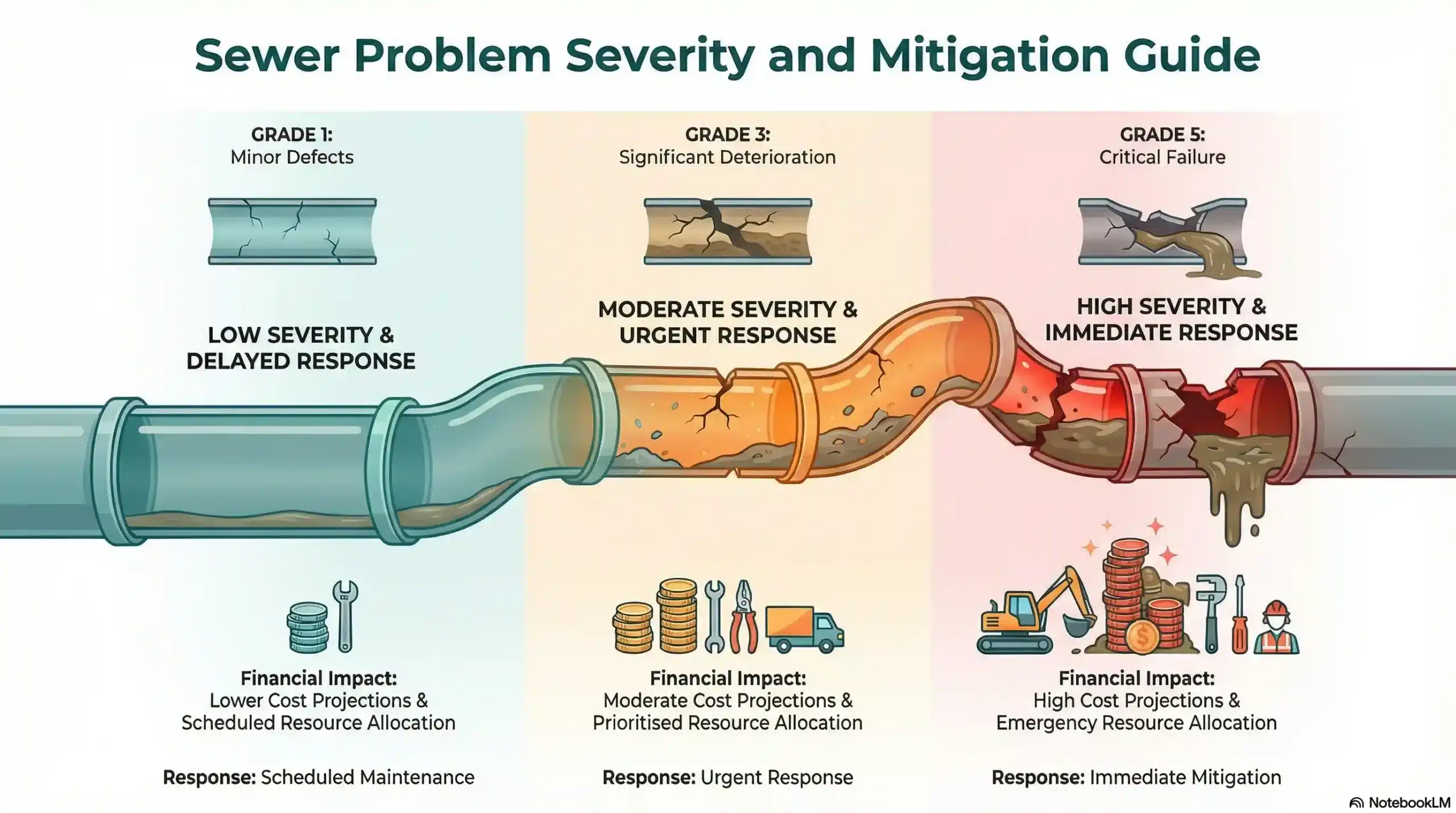
Serious Problems (Immediate Attention Required)
Collapsed pipe sections appear as complete breaks where pipe structure has failed. These create immediate backup risks and require emergency repair to prevent sewage overflow into your property. Complete section replacement typically costs $8,000-15,000.
Major pipe offsets show significant misalignment between pipe sections, usually caused by severe soil movement or settling. These conditions prevent proper waste flow and worsen rapidly during weather changes.
Complete blockages prevent camera advancement and indicate total flow obstruction. While clearing might temporarily restore function, the underlying cause usually requires structural repair to prevent recurrence.
Separated joints with significant displacement allow sewage to leak into surrounding soil, creating health hazards and environmental concerns. These conditions require immediate repair to prevent groundwater contamination and foundation damage.
Location Impact on Repair Complexity
Problems under driveways, sidewalks, or landscaping cost significantly more to repair due to restoration requirements. Precise location identification helps estimate total repair costs, including surface restoration.
Depth affects repair complexity and cost. Lines deeper than 6 feet require more extensive excavation and safety precautions. Our locating equipment determines depth as well as horizontal position, providing complete repair planning information.
Distance from street connection influences repair options. Problems near the house foundation allow easier access but risk structural damage. Issues near street connections may require coordination with city utilities and permit processes.
Proximity to utilities like gas, electric, or water lines affects excavation methods and costs. Our locating services identify these potential conflicts before repair work begins, preventing dangerous accidents and additional expenses.
Northern Colorado Sewer Inspection Investment: Transparent Cost Analysis
Professional sewer scope inspections cost $275 in our service area, covering complete main line evaluation from house to street connection with HD recording and expert analysis included. This investment protects against repair costs that typically range from $2,000 for minor sections to $15,000 for complete line replacement.
Complete Service Breakdown
Our comprehensive inspection includes high-definition video camera evaluation with wireless locating capability, providing both visual assessment and precise problem positioning. The service covers your entire main sewer line, typically 60-100 feet depending on your property layout.
Real-time monitoring allows you to observe the inspection process and ask questions as findings emerge. This transparency ensures you understand exactly what we’re seeing and what it means for your situation.
Professional video recording creates permanent digital documentation delivered same day via email. These files serve as baseline records for future comparisons, contractor consultations, and real estate documentation needs.
Written analysis accompanies the video, explaining findings in practical terms with recommendations for timing and priority of any needed actions. This report format helps you make informed decisions rather than simply documenting problems.
The 1-year labor warranty covers any follow-up work performed by our team, providing additional peace of mind for repair services. This warranty reflects our confidence in both diagnostic accuracy and repair quality.
Investment vs. Risk Analysis
The $275 inspection cost represents protection against surprise repairs averaging $8,000-12,000 for major sewer line problems. Emergency repairs cost 40-60% more than planned work due to urgent scheduling requirements and difficult working conditions.
Consider that sewer line failure often causes secondary damage to flooring, personal belongings, and landscaping. Cleanup costs for sewage backups frequently exceed the repair costs, not including health hazards and temporary housing expenses.
Insurance coverage for sewer line problems varies significantly between policies. Many standard homeowner’s policies exclude sewer line coverage, making personal financial responsibility even more critical. Documentation from professional inspections can support insurance claims when coverage does exist.
Service Area and Scheduling
We serve Greeley, Evans, Eaton, Windsor, Johnstown, and surrounding Weld County communities without additional travel charges. Same-day scheduling accommodates urgent real estate transaction deadlines when needed.
Payment options include cash, check, and all major credit cards. Real estate transaction payments can be coordinated between buyers and sellers through established escrow procedures.
Extended service area coverage reaches Fort Collins and Loveland by special arrangement, with minimal additional travel charges for these locations. Scheduling flexibility accommodates weekend and evening appointments when necessary for real estate deadlines.
Quality Investment Rationale
Master plumber services cost more than basic home inspector add-ons because of equipment investment, expertise level, and comprehensive insurance coverage. The price difference reflects professional-grade equipment, immediate repair capability, and accountability that basic inspection services cannot provide.
Home inspectors typically charge $150-200 for sewer scoping as an additional service using entry-level equipment. The $75-125 difference in cost provides significantly superior diagnostic capability and expert interpretation that proves valuable when problems are discovered.
Professional liability insurance covers both inspection accuracy and repair work quality, providing protection that many basic inspection services cannot offer. This insurance backing demonstrates our commitment to professional standards and customer protection.
Strategic Timing: When Sewer Scope Inspections Provide Maximum Value
Schedule sewer inspections immediately when purchasing homes over 15 years old, before major renovations, or when experiencing recurring drain problems, as timing affects both problem detection accuracy and your response options. Different situations require different approaches to timing and urgency.
Home Purchase Strategy
Include sewer scope inspection requirements in your purchase offer contingencies, particularly for homes built before 1990. Complete inspections within 7-10 days of contract acceptance to allow adequate time for repair negotiations if problems are discovered.
Never waive sewer inspection requirements to strengthen competitive offers. The potential savings from a faster acceptance rarely exceed the risk of inheriting major sewer line problems. Properties with existing clean sewer scope reports can justify higher offers with confidence.
Pre-approval for inspection scheduling allows faster response when offers are accepted. Having our contact information and availability preferences established streamlines the process when time becomes critical in competitive real estate markets.
Optimal Seasonal Timing
Spring inspections conducted in April and May reveal winter freeze damage most clearly. Late summer evaluations in August and September show drought-related soil settling effects on pipe stability.
Avoid inspection scheduling during heavy rain periods when excess water entering the system can obscure camera visibility and mask certain types of problems. Moderate weather conditions provide the clearest diagnostic results.
Fall scheduling before winter freeze-up allows time for repairs before ground conditions make excavation difficult. Winter inspections remain possible but may not reveal the full extent of freeze-related damage until spring thaw occurs.
Existing Homeowner Warning Indicators
Schedule immediate inspection if you experience frequent drain backups affecting multiple fixtures, gurgling sounds when water drains, sewage odors near your foundation, or unusually green grass patches in your yard during dry periods. These symptoms indicate developing problems that typically worsen rapidly without intervention.
Water backing up in basement floor drains during heavy water usage signals main line restrictions that require professional evaluation. Ignoring these early warnings often leads to emergency situations during inconvenient times.
Slow drainage throughout the house suggests partial blockages that may indicate structural problems rather than simple clogs. Professional evaluation determines whether the issue stems from individual fixture problems or main line restrictions.
Pre-Listing Considerations for Sellers
Conducting sewer scope inspections 30-60 days before listing provides time for repair completion and positive marketing positioning. Homes with recent clean sewer scope documentation often attract serious buyers and support asking price justification.
Proactive problem identification allows you to control repair timing, contractor selection, and cost management rather than responding to buyer inspection demands during negotiations.
Clean inspection reports become valuable marketing tools that demonstrate property maintenance and reduce buyer concerns about hidden problems. This documentation often justifies premium pricing and faster sales in competitive markets.
Building Long-Term Sewer System Health: Beyond Problem Detection
Sewer scope inspection serves as the foundation for strategic maintenance planning, preventing emergencies through informed decision-making rather than reactive crisis management. The goal extends beyond identifying current problems to developing comprehensive property protection strategies.
Preventive Maintenance Development
Inspection findings determine appropriate maintenance intervals for your specific situation. Properties with light root intrusion benefit from annual cleaning services costing $200-400. Older systems with minor structural issues require monitoring every 2-3 years to track condition changes.
Properties with clean lines in newer construction can safely extend intervals to 5-7 years between comprehensive evaluations, depending on local soil conditions and vegetation factors around your specific location.
Maintenance scheduling coordinates with other property care activities, creating efficiency and cost savings through combined service visits. Spring maintenance aligns with irrigation system startup and landscaping projects.
Repair Priority Planning
Not every identified problem requires immediate action. Understanding which issues present urgent risks versus those suitable for planned future handling helps avoid emergency pricing while ensuring safety and function.
Strategic repair timing takes advantage of seasonal factors, contractor availability, and coordination with other property maintenance activities. Planning repairs during favorable weather conditions and non-emergency timeframes typically reduces costs by 25-40%.
Budget planning becomes possible when you understand your system’s condition and likely future needs. This knowledge allows for strategic financial preparation rather than emergency expense management.
Property Value Documentation
Maintaining comprehensive records of sewer line condition supports insurance claims, protects against real estate disputes, and demonstrates responsible property stewardship to future buyers. Documented maintenance history often influences buyer confidence and negotiation positions.
Some insurance providers offer discounts for properties with documented preventive maintenance programs, recognizing that proactive care reduces claim likelihood and severity.
Digital documentation provides permanent records that survive property ownership changes, helping future owners understand system history and maintenance needs.
Emergency Prevention Strategy
Regular evaluation prevents unexpected sewage backups that damage flooring, furniture, and personal belongings while creating health hazards. Emergency cleanup costs often exceed repair expenses, particularly when temporary housing becomes necessary.
Understanding your system’s condition allows you to recognize early warning signs and respond before crisis situations develop. Most major sewer failures provide advance indicators that trained evaluation can identify.
Emergency service availability provides peace of mind when you know your system’s vulnerabilities and have established relationships with qualified repair professionals.
Local Resources & Citations
City of Greeley Utilities Department: Official information about municipal sewer connections, permit requirements, and homeowner responsibility boundaries for sewer line maintenance and repairs.
Colorado State University Extension – Weld County: Research-based information about local soil conditions, including expansive clay characteristics that affect underground utilities and foundation systems.
Weld County Building Department: Permit requirements, inspection procedures, and code compliance information for sewer line repairs and major plumbing modifications.
Colorado Department of Public Health and Environment: State regulations governing wastewater systems, health safety requirements, and environmental protection standards for sewer line maintenance and repair.
Taking Action: Your Next Steps for Sewer Line Evaluation
Scheduling professional sewer scope inspection requires minimal preparation and typically accommodates most timeline needs within 2-3 business days. Understanding the process helps you prepare appropriately and know what to expect throughout the evaluation.
Scheduling Process
Contact us directly for an immediate response, use our online scheduling system for convenient appointment setting, or send a text message for quick questions and availability checks. We coordinate timing around real estate deadlines, work schedules, and other contractor visits as needed.
Most comprehensive inspections require 60-90 minutes from arrival to completion, depending on line length and access conditions. We provide estimated timing when scheduling and update you if conditions require additional time.
Emergency scheduling accommodates urgent situations like active backups or real estate deadline pressures. After-hours and weekend availability ensures that your timeline needs can be met when circumstances require immediate attention.
Service Day Preparation
Minimize heavy water usage for 2-3 hours before inspection to ensure optimal camera visibility. Avoid running dishwashers, washing machines, or taking long showers immediately before our arrival. Light water usage for normal daily activities doesn’t interfere with inspection quality.
We handle all technical preparation, including locating your sewer cleanout access point and any minor clearing needed for camera insertion. No special property access arrangements or additional preparation steps are required from homeowners.
Clear access to potential cleanout locations helps expedite the process. These typically exist near your foundation, often marked with a circular or square cover flush with the ground surface.
What to Expect During Inspection
Our technician arrives with professional equipment and clearly marked service vehicles. We explain the process, locate your system access points, and walk you through what appears on the monitor as inspection progresses.
You’re welcome to observe the entire process and ask questions in real time, or handle other activities while we work. The live monitoring capability means you see exactly what we’re seeing as we evaluate each section of your sewer line.
Professional documentation includes video recording with distance markings, still photographs of significant findings, and real-time location marking when problems are identified.
Report Delivery and Follow-Up
Digital video files and written analysis reach you by email within hours of inspection completion. You receive permanent records suitable for contractor consultations, insurance documentation, and future reference needs.
Rush delivery accommodates urgent real estate transaction deadlines when necessary. We also provide phone consultation to discuss findings and answer questions about implications or recommendations.
Follow-up consultation remains available for questions that arise after you’ve reviewed the documentation. Understanding your options and timeline helps you make the best decisions for your specific situation.
Service Coverage Area
We provide comprehensive service throughout Greeley, Evans, Eaton, Windsor, Johnstown, and surrounding Weld County communities without additional travel charges. Limited service extends to the Fort Collins and Loveland areas by special arrangement.
También ofrecemos servicios de limpieza de drenajes en español—Spanish language service is available for our Spanish-speaking community members.
Local expertise includes understanding of municipal requirements, permit processes, and environmental factors specific to Northern Colorado conditions.
FAQs
-
A professional sewer scope inspection in Northern Colorado typically costs around $275. Emergency inspections may cost more, but this small investment prevents expensive surprise excavation repairs.