
How Much Does Drain Cleaning Cost in Greeley, CO? (2026 Pricing Guide)
You’re standing in your kitchen, watching dirty water creep up from the sink drain despite running the garbage disposal twice. Sound familiar? Before you grab that bottle of chemical drain cleaner or dial the first “$79 drain cleaning” ad you see, understanding what drives actual costs in Greeley could save you hundreds—and prevent expensive damage to your home’s plumbing system.
Should You Call a Professional? When Greeley Homeowners Can Handle It Themselves
Featured Snippet Answer: Most single-drain slow drainage issues can be resolved with plunging if water eventually moves through the system. Call a professional immediately when multiple drains back up simultaneously, sewer odors appear inside your home, or water backs up from basement floor drains—these indicate main sewer line problems requiring specialized equipment.
The dividing line between DIY and professional intervention isn’t about your skill level—it’s about understanding what your specific symptoms actually indicate.
Simple Issues You Can Address
If your kitchen sink drains slowly but responds to plunging, you’re dealing with localized grease and food particle buildup. Hot water flushes (not boiling, which can crack older pipes) combined with dish soap often restore normal flow within 24 hours.
Bathroom sink slowdowns from visible hair and toothpaste accumulation respond to manual removal followed by hot water flushing. If you can see the obstruction and extract it easily, the problem typically stays solved.
Greeley’s Geographic Red Flags
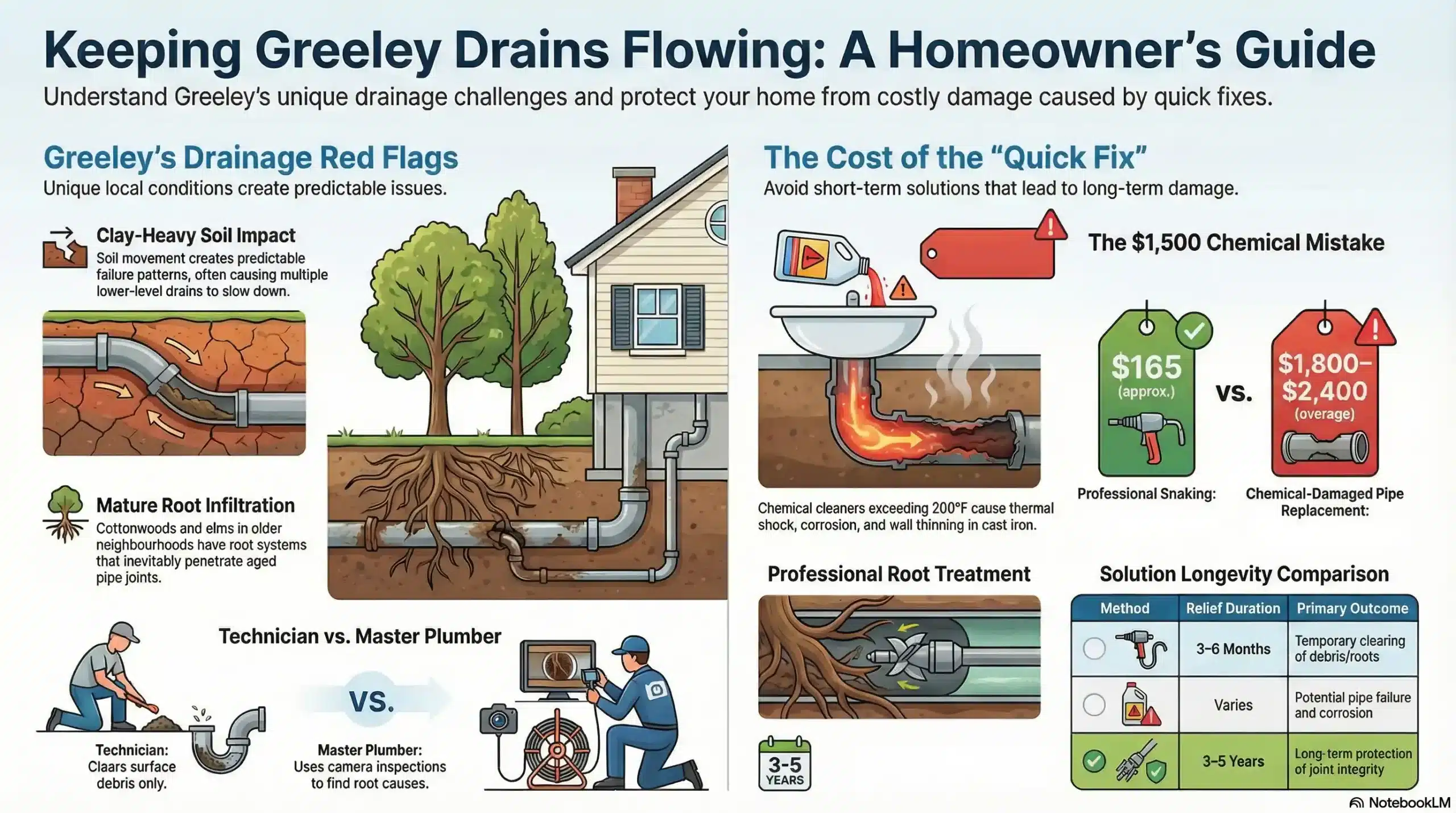
Greeley’s clay-heavy soil creates predictable failure patterns that homeowners often misinterpret as simple clogs. When multiple fixtures drain slowly—especially lower-level drains like basement sinks or floor drains—you’re likely seeing soil movement effects on your underground lines.
West Greeley’s established neighborhoods near 10th Street and historic areas around Lincoln Park feature homes built between 1950-1980 with mature cottonwoods planted 30+ feet from structures. These trees were planted when modern utility placement guidelines didn’t exist, creating inevitable conflicts as root systems matured.
The $1,500 Chemical Mistake
Hardware store drain cleaners generate temperatures exceeding 200°F to dissolve organic matter. Cast iron drain lines installed in 1950s-1960s Greeley homes can’t withstand thermal shock from repeated chemical treatments.
We document three to four complete drain line replacements monthly where aggressive chemical use created joint failures, pipe wall thinning, and connection point corrosion. These replacements average $1,800-$2,400 when the original drainage issue could have been resolved with $165 professional snaking.
Diagnostic Indicators: Technician vs. Master Plumber Assessment
General plumbing technicians focus on clearing immediate blockages using standard equipment. This approach works for surface-level accumulations but misses structural issues that create recurring problems.
Master plumbers evaluate root causes during initial assessment. In Greeley’s established neighborhoods where American elms, silver maples, and cottonwoods were planted 40+ years ago, camera inspection reveals whether you’re dealing with debris accumulation or root mass infiltration—fundamentally different problems requiring different solutions.
When root systems have penetrated separated joints (common in clay soil areas where ground movement is constant), mechanical snaking provides 3-6 months of relief before roots regrow. Professional root cutting with preventive treatment addresses the infiltration points, typically extending problem-free periods to 3-5 years.
Call for Emergency Service
Multiple drains backing up or sewer odors in your home? These situations worsen quickly and require immediate professional attention to prevent property damage.
What Drives Drain Cleaning Costs in Greeley: 2026 Pricing Breakdown
Featured Snippet Answer: Standard drain cleaning in Greeley costs $150-$185 for accessible drains using mechanical snaking equipment. Costs increase to $300-$500 when camera inspection ($125-$150), hydro jetting ($200-$350), or main sewer line access ($300-$500) becomes necessary based on blockage location and severity.
Understanding price escalation factors helps you budget accurately and recognize when “starting at $79” advertising becomes “$400+ final billing.”
Base Service Investment
Professional drain cleaning in Greeley starts at $150-$185 for standard mechanical clearing when:
- Cleanout access requires no excavation or fixture removal
- Blockage location is within 25 feet of access point
- Standard snaking equipment resolves the issue completely
- Single fixture is affected
This covers approximately 60% of residential service calls in Greeley’s newer developments (post-1990 construction with PVC drain lines and proper cleanout placement).
Cost Escalation Triggers
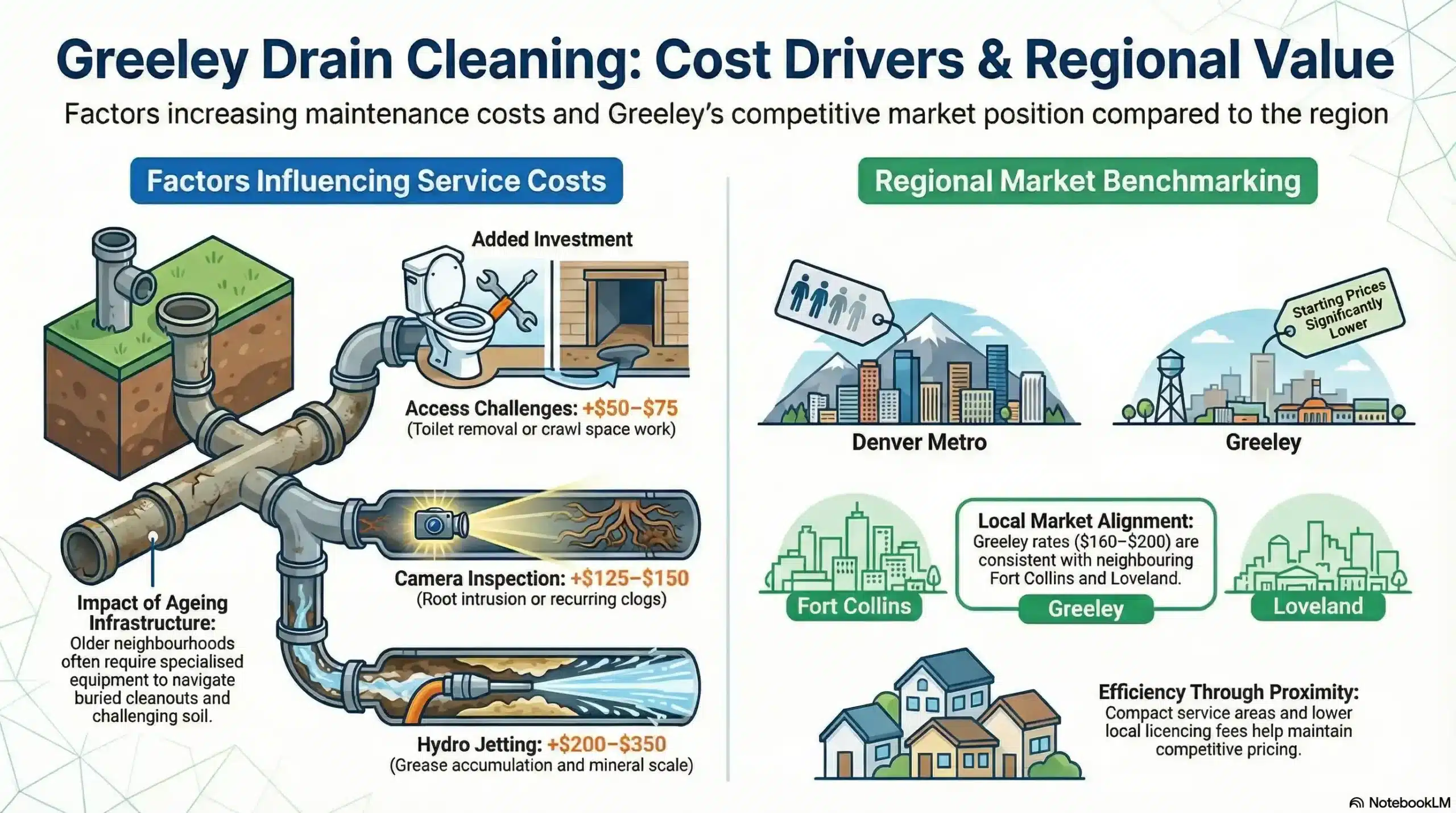
| Service Requirement | Added Investment | Common Greeley Scenarios |
|---|---|---|
| Access Challenges | +$50-$75 | Toilet removal for closet bend access, crawl space work in 1960s ranch homes, buried cleanouts in older neighborhoods |
| Camera Inspection | +$125-$150 | Recurring monthly clogs, suspected root intrusion, and multiple fixture involvement |
| Hydro Jetting | +$200-$350 | Restaurant grease accumulation, mineral scale in hard water areas, and root cutting in established trees |
| Main Line Work | +$300-$500 | System-wide backups, sewer odors, and basement floor drain involvement |
Regional Cost Context
Greeley’s drain cleaning costs align with Fort Collins ($160-$200) and Loveland ($155-$195) but remain 15-20% below Denver metro pricing ($200-$275 starting points).
The cost difference reflects operational factors: Greeley’s compact service area reduces travel time between calls, and local licensing fees are lower than in metro areas. However, the prevalence of older infrastructure and challenging soil conditions often requires specialized equipment, balancing these advantages.
Transparent Pricing vs. Markup Models
Many local competitors advertise “$79 starting prices,” then apply escalating charges:
Typical Escalation Pattern:
- $79 basic service attempt
- $75 diagnostic fee (when basic service fails)
- $100 camera inspection requirement
- $150 hydro jetting upgrade
- $25 cleanup and disposal
- Total: $429 (compared to $300 transparent flat-rate pricing)
The markup model creates pressure situations where homeowners feel obligated to approve additional charges once technicians have deployed equipment and begun work.
Get Expert Assessment
Unsure whether your drainage issue requires cleaning, repair, or replacement? Our master plumbers provide honest evaluations with no pressure to purchase additional services.
Why “$79 Drain Cleaning” Costs More Than Professional Service
You’ve seen the ads promising drain cleaning “starting at $79” and wondered if professional services charging $200+ are overpriced. Here’s what actually happens when pricing seems too good to be true.
Featured Snippet Answer: Budget drain cleaning services averaging $79 initial charges typically cost $300-$450 after diagnostic fees, equipment upgrades, and repeat visits are added. Professional services costing $200-$300 upfront often provide better long-term value by addressing root causes rather than symptoms.
The Revenue Model Behind Low-Price Advertising
Companies using “$79 starting” pricing depend on service call conversion to profitable work. The advertised price covers basic equipment deployment and simple snaking attempts—adequate for less than 30% of actual drainage problems.
Real-World Escalation Example: A Greeley homeowner with kitchen sink backup called a “$79 service” last month. The final invoice included:
- $79 basic service (unsuccessful clearing attempt)
- $75 diagnostic assessment (required after basic service failed)
- $125 camera inspection (revealed grease buildup beyond snaking reach)
- $175 hydro jetting (required to remove accumulated material)
- Total: $454
The same issue resolved through comprehensive initial assessment would have cost $285 with complete clearing guaranteed.
Warranty Implications for Older Greeley Homes
PVC drain lines installed during Greeley’s 1980s-1990s building boom carry manufacturer warranties extending 25-50 years. Aggressive chemical treatments and improper mechanical techniques void these warranties, leaving homeowners responsible for premature failure costs.
We document warranty-voiding damage monthly: aggressive snaking that scores pipe interiors, chemical treatments that weaken solvent joints, and high-pressure techniques that separate connections. Replacement costs for voided warranty lines average $3,200-$6,800.
Professional service methods preserve manufacturer warranties through approved techniques and proper documentation. This protection maintains your plumbing system’s asset value and provides recourse for premature failures.
The Recurring Service Revenue Model
Budget providers focus on immediate blockage clearing without addressing underlying causes. In Greeley’s mature neighborhoods, this creates predictable callback patterns:
Six-Month Cycle Example:
- Month 1: $85 service call (temporary clearing)
- Month 3: $95 repeat service (same location, same issue)
- Month 6: $110 third service (problem worsening)
- Month 8: $125 emergency weekend call
- Annual Total: $415 plus ongoing deterioration
Root cause analysis during initial service typically costs $265-$315 but eliminates recurring problems for 3-5 years. The investment difference pays for itself within the first year while preventing emergency situations.
Quality Equipment and Training Differences
Professional drain cleaning companies invest in camera inspection systems, variable-pressure hydro jetting equipment, and specialized root cutting tools. This equipment costs $15,000-$25,000 per service vehicle but enables complete problem resolution during single visits.
Budget operators typically carry basic mechanical snakes and rely on aggressive techniques when standard equipment proves insufficient. This limitation creates the recurring service model while potentially damaging your plumbing system.
Greeley’s Unique Drainage Challenges: Why Location Affects Your Costs
Your neighbor in Fort Collins might pay $150 for drain cleaning that costs $250 in your Greeley home. The difference isn’t arbitrary—it reflects specific local conditions that affect both service complexity and long-term reliability.
Featured Snippet Answer: Greeley’s expansive clay soil, freeze-thaw cycles, and 1950s-1980s housing stock create drainage challenges requiring specialized equipment and local expertise. Clay soil movement causes joint separations, while mature tree systems in older neighborhoods create predictable root intrusion patterns affecting service complexity and costs.
Clay Soil’s Impact on Underground Infrastructure
Greeley sits on Bentonite clay deposits that expand up to 15% when saturated and shrink proportionally during dry periods. This constant movement stresses underground pipes and creates the microscopic separations where tree roots infiltrate systems.
The soil composition affects service approaches: standard snaking equipment can’t address root masses that exploit expanded joints during wet periods. These situations require specialized root cutting equipment and camera inspection to locate all intrusion points—services that add $200-$350 to basic drain clearing.
Clay also retains moisture around pipes longer than sandy soils, creating ideal growing conditions for root systems. In neighborhoods where trees were planted 40+ years ago, roots have had decades to locate and exploit any weak points in drainage infrastructure.
Freeze-Thaw Cycle Effects on Aging Systems
Northern Colorado’s temperature variations (commonly 40-50°F daily swings during transitional seasons) create repeated expansion and contraction in underground systems. While modern PVC handles this movement well, cast iron and clay materials installed during Greeley’s mid-century building boom show predictable failure patterns.
Cast iron drain lines from 1950s-1960s construction develop joint compound failures after 60+ years of thermal cycling. These failures allow root intrusion and debris accumulation at connection points—problems requiring hydro jetting or camera-guided repairs rather than simple snaking.
Winter service calls often involve grease congealing in cold pipes combined with reduced water flow during heating season. This creates harder blockages requiring higher-pressure clearing techniques.
Housing Era Infrastructure Patterns
Greeley’s concentrated building periods created predictable plumbing challenges:
1950s-1960s Construction:
- Cast iron drain lines developing rust scale after 65+ years
- Joint failures at connection points from thermal cycling
- Inadequate slope in original installations (pre-modern code requirements)
1960s-1970s Construction:
- Clay pipe sewer lines becoming brittle from soil movement
- Tree plantings that violate modern utility clearance guidelines
- Septic system conversions creating junction point weak spots
1970s-1980s Construction:
- Early PVC installations with solvent joints susceptible to thermal stress
- Transitional period plumbing combining materials with different expansion rates
- Builder-grade fixtures requiring more frequent maintenance
Understanding these patterns helps explain why neighboring homes experience similar drainage issues and why preventive maintenance scheduling proves cost-effective for entire neighborhoods.
Water Table Variations Across Greeley
South Greeley’s elevation differences create varying groundwater pressure on sewer systems. Homes in lower elevations below 11th Avenue experience seasonal drainage variations unrelated to blockages but caused by external hydrostatic pressure.
During spring snowmelt periods, elevated groundwater can cause basement floor drains to back up even when main sewer lines remain clear. This requires specialized assessment to distinguish between actual blockages and pressure-related backup issues.
Neighborhoods near irrigation canal systems see predictable seasonal patterns that experienced local technicians recognize, preventing unnecessary service calls and misdiagnosis.
Tree Species and Root Behavior Patterns
Greeley’s mature landscaping features tree varieties that create specific root intrusion patterns:
Cottonwoods: Aggressive surface root systems extending 60+ feet from trunk, rapid regrowth after cutting American Elms: Dense fibrous root mats that trap debris and create recurring backup issues
Silver Maples: Deep taproot systems that seek water sources and penetrate joints completely
The distance between mature trees and sewer lines in established neighborhoods often violates current utility placement guidelines. Trees planted 25-30 feet from structures in the 1970s now have root systems reaching and damaging underground infrastructure.
Ready to resolve your drainage issues with transparent pricing and guaranteed results? Most appointments are available within 48 hours with no emergency fees.
When Drain Cleaning Isn’t Enough: Repair vs. Replacement Decisions
After spending $200 on professional drain cleaning, you’re frustrated to see the same slow drainage returning within six months. Understanding when cleaning transitions to repair—and repair transitions to replacement—prevents throwing good money after bad.
Featured Snippet Answer: Consider repair over repeated cleaning when camera inspection shows 40-60% blockage from root intrusion or localized pipe damage. Choose replacement over repair when multiple fixtures back up repeatedly, camera inspection reveals >70% structural blockage, or groundwater infiltration indicates widespread system failure.
Clear Threshold Indicators for Each Approach
Cleaning Sufficiency Indicators:
- Single fixture involvement with accessible blockage
- Grease or debris accumulation in structurally sound pipes
- Recent installation (less than 20 years) with proper maintenance
- Camera inspection showing <30% pipe diameter reduction
Repair Candidacy Indicators:
- Localized root intrusion at 1-2 joint locations
- Partial pipe sagging creating standing water zones
- Scale buildup in specific sections rather than system-wide
- 40-60% blockage in otherwise structurally sound infrastructure
Replacement Necessity Indicators:
- Multiple fixture backups returning within 30-60 days of service
-
70% pipe diameter reduction from collapse, scale, or root mass
- Groundwater infiltration creating continuous drainage issues
- Structural cracks allowing soil infiltration
Investment Comparison for Typical Greeley Scenarios
| Approach | Cost Range | Expected Lifespan | Ideal Application |
|---|---|---|---|
| Hydro Jetting + Maintenance | $265-$385 | 2-5 years | Grease accumulation, minor root intrusion, scale removal |
| Spot Repair (Pipe Lining) | $850-$1,350 | 12-18 years | Single joint failures, localized root damage |
| Partial Line Replacement | $1,650-$3,200 | 30-50 years | Section failure with sound remaining system |
| Complete System Replacement | $3,800-$8,500 | 50+ years | Multiple failure points, system-wide deterioration |
Long-Term Value Analysis
Maintenance Approach Example: A 1975 Greeley home with minor root intrusion at one joint location:
- Annual hydro jetting: $285 × 4 years = $1,140
- Moderate effectiveness with 6-12 month service intervals
- Gradual root regrowth requiring increased service frequency
Spot Repair Example:
Same home with targeted pipe lining at intrusion point:
- One-time investment: $1,150
- 15-year expected performance with minimal maintenance
- Total cost advantage after year 5, significant savings over system lifetime
Replacement Consideration: When multiple joints show deterioration or system-wide issues develop:
- Partial replacement: $2,400 for 40 feet of main line
- Eliminates recurring service needs for 40+ years
- Increases home value and provides warranty protection
Master Plumber Evaluation Benefits
Licensed master plumbers assess entire plumbing systems rather than individual drain problems. This perspective identifies whether drainage issues indicate broader infrastructure concerns affecting repair vs. replacement decisions.
System-Wide Assessment Advantages:
- Coordination opportunities (combining drain work with water line replacement)
- Code compliance evaluation for future resale considerations
- Permitting navigation for replacement work
- Warranty protection through proper installation documentation
For example, if drain line replacement becomes necessary but water service lines also show aging indicators, coordinating both projects reduces excavation costs by 30-40% compared to separate interventions.
Comprehensive plumbing system evaluation often identifies efficiency opportunities that individual problem-focused approaches miss.
Avoiding Predatory Practices: Red Flags in Drain Cleaning Services
Last week, a Greeley homeowner called us after another company quoted $2,800 for sewer line replacement—work we completed with $185 drain cleaning. Understanding common deceptive practices protects your investment and ensures appropriate solutions for your specific situation.
Featured Snippet Answer: Avoid drain cleaning services offering “free estimates” that become mandatory charges, “starting at” pricing without clear escalation rules, or immediate pressure for expensive repairs. Verify Colorado plumber license numbers through DORA database and request local references from past 12 months before authorizing work.
Pricing Structure Warning Signs
“Free Estimate” Trap: Legitimate drain cleaning companies provide accurate phone estimates for standard services. “Free estimates” requiring on-site visits often become mandatory service charges ($75-$125) regardless of work authorization.
“Starting At” Price Manipulation: Professional companies provide realistic price ranges covering 85-90% of typical situations. “Starting at $79” advertising typically excludes diagnostic fees, equipment charges, and cleanup costs—creating pressure situations once technicians arrive.
Same-Day Payment Pressure: Established businesses accept standard payment methods and provide detailed invoices. Cash discount offers or same-day payment demands often indicate unlicensed operators or companies with cash flow problems.
Service Approach Red Flags
Immediate Emergency Claims: Most drain issues aren’t true emergencies requiring immediate expensive intervention. Claims of “sewage backup risk” or “foundation damage potential” often target vulnerable homeowners for unnecessary major work.
Equipment Limitation Indicators: Professional services use camera inspection to verify complete clearing and identify underlying issues. Companies without diagnostic equipment typically provide temporary solutions requiring recurring service calls.
Reference Avoidance: Established Greeley companies maintain dozens of local customer relationships and willingly provide recent references. Reluctance to share local testimonials raises quality and reliability questions.
Credential Verification Requirements
Colorado Licensing Verification: State law requires license number display on vehicles, advertising, and service estimates. Verify these numbers through Colorado Department of Regulatory Agencies (DORA) online database before authorizing work.
Master Plumber vs. Journeyman Distinction: Master plumber credentials indicate advanced training and complex problem-solving capability. While journeyman plumbers handle routine drain clearing competently, master plumbers provide comprehensive system evaluation.
Local Certification Benefits: City of Greeley vendor status and ATMOS Energy partnerships require background verification and ongoing performance standards. These certifications indicate established local presence and accountability.
Documented Problematic Patterns
Based on customer experiences we encounter regularly, certain local companies demonstrate concerning business practices:
Elite Rooter Pattern Recognition:
- $79 initial quotes becoming $400+ final bills through progressive upselling
- Pressure tactics for immediate work authorization without explanation periods
- Recurring problems after service indicating incomplete or temporary solutions
- Emergency replacement recommendations that standard cleaning resolves
Multiple Greeley customers contact us monthly after Elite Rooter diagnosed expensive replacement work resolved through routine professional service, suggesting either diagnostic incompetence or intentional upselling practices.
Pre-Service Verification Questions
Scope and Pricing Clarity: “What exactly does your quoted price include?” should receive detailed responses covering diagnosis, cleaning, equipment use, cleanup, and warranty terms. Vague answers like “depends what we find” indicate potential surprise billing.
Equipment and Capability Verification: “Do you provide camera inspection as standard practice?” separates professional diagnostic services from basic snaking operations that may miss underlying problems.
Warranty and Service Standards: “What warranty do you provide on drain cleaning work?” Professional companies confidently warrant their work for 60-90 days. Warranty avoidance indicates uncertainty about service effectiveness.
Local Presence Confirmation: “Can you provide three local references from the past year?” establishes genuine local operation and customer satisfaction levels. Companies without readily available references may lack local experience or customer satisfaction.
Verification of credentials and references takes 10-15 minutes but prevents costly mistakes and ensures appropriate solutions for your specific drainage challenges.
Getting Professional Drain Cleaning in Greeley: Your Action Plan
You’ve determined professional service is necessary, but you’re unsure about timing, what information to gather, or what to expect during the process. Here’s how to ensure efficient service and optimal results for your investment.
Featured Snippet Answer: Call immediately for multiple drain backups, sewer odors, or basement floor drain issues—these indicate main line problems requiring same-day attention. For single-drain slow drainage, schedule within 48-72 hours to prevent escalation while avoiding emergency service premiums.
Emergency vs. Routine Service Timing
Immediate Response Required:
- Multiple fixtures backing up simultaneously (indicates main sewer blockage)
- Sewer gas odors inside living spaces (potential health and safety hazard)
- Basement floor drain backup during normal usage (not weather-related)
- Raw sewage appearance in any indoor fixture
These conditions worsen rapidly once initiated and can cause property damage or health hazards if delayed.
48-72 Hour Scheduling Appropriate:
- Single fixture slow drainage without odors or backup
- Recurring monthly drainage issues with manageable flow
- Preventive maintenance for known problem areas
- Seasonal service before high-usage periods
Scheduling non-emergency issues within this timeframe prevents escalation while avoiding emergency service premiums (typically 25-35% above standard rates).
Seasonal Service Planning Calendar
Spring (March-April): Schedule after snowmelt to address winter damage from freeze-thaw cycles. Ideal timing before ground movement affects older pipe systems.
Summer (May-September): Optimal conditions for major repairs with favorable excavation weather. Best time for replacement work if needed.
Fall (October-November): Preventive cleaning before reduced winter flow patterns allow buildup to solidify. Prepare systems for heating season demands.
Winter (December-February): Emergency-only service with premium rates due to challenging conditions and equipment setup requirements.
Information Assembly for Efficient Service
Property Details:
- Home construction year (determines likely pipe materials and installation methods)
- Previous drain cleaning history with dates and service providers
- Location of affected fixtures and any symptom patterns observed
- DIY attempts including chemical products used or mechanical interventions
Symptom Documentation:
- Which drains show problems first during backup episodes
- Timing patterns (morning, evening, after specific activities)
- Sound characteristics (gurgling, bubbling, unusual noises)
- Odor descriptions and locations where detected
This information enables technicians to select appropriate equipment and approach strategies before arrival, reducing service time and improving first-visit success rates.
Service Process Expectations
Initial Assessment Phase (15-25 minutes):
- Visual inspection of affected fixtures and accessible cleanouts
- Water flow testing to determine blockage severity and location
- Discussion of symptom history and previous service attempts
- Equipment selection based on findings
Diagnostic Phase (varies by complexity):
- Camera inspection for recurring issues or multiple fixture involvement
- Pressure testing for suspected main line problems
- Root intrusion assessment in mature neighborhood settings
- Structural evaluation for older home systems
Treatment Execution:
- Clear explanation of recommended approach with pricing
- Work authorization before equipment deployment
- Progress monitoring with customer communication
- Completion verification through flow testing
Follow-Up Documentation:
- Service record including specific procedures performed
- Recommendations for prevention or maintenance scheduling
- Warranty terms and contact procedures for concerns
- Future service planning based on findings
Investment Protection and Long-Term Planning
Warranty Coverage Understanding: Professional drain cleaning includes 60-90 day warranty on specific work performed. If identical blockage returns at the same location within warranty period, return service occurs without additional charges.
Maintenance Scheduling Benefits: Annual or bi-annual preventive service costs 40-50% less than emergency calls while extending equipment life and preventing system failures. Scheduling aligns with seasonal demand patterns for cost efficiency.
Documentation Value: Maintaining service records helps identify system patterns, predict future needs, and provide warranty documentation for equipment or home sale purposes.
Why Local Expertise Matters: Top-Notch vs. Competitors
| Service Factor | Top-Notch | Typical Competitors |
|---|---|---|
| Master Plumbers | 3 Licensed Masters | 0-1 Master Plumbers |
| Local Recognition | 5-Year Best of Greeley Winner | No Local Awards |
| Vendor Status | City of Greeley Preferred | Standard Licensing Only |
| Experience | 60+ Years Combined Local | Variable/Unknown |
| Warranty | 1-Year Labor Guarantee | 30-90 Days Typical |
Community Investment Perspective: Local ownership means reputation depends on neighbor satisfaction rather than corporate metrics. Five consecutive “Best of Greeley” awards (2020-2024) reflect community recognition of consistent service quality.
Regional Knowledge Applications: Understanding Greeley’s specific soil conditions, housing construction patterns, and utility infrastructure enables more accurate diagnosis and appropriate solution selection compared to regional or national service providers.
Established Relationships: City of Greeley preferred vendor status and ATMOS Energy partnership demonstrate compliance with local standards and utility coordination capabilities. These relationships provide resources for complex situations requiring utility involvement.
Technical Expertise Depth: Three Colorado licensed master plumbers with combined 60+ years local experience provide problem-solving capabilities that general technicians cannot match. Master plumber assessment often prevents recurring issues that keep other service providers returning repeatedly.
Ready to resolve your drainage issues with transparent pricing and guaranteed results? Most appointments available within 48 hours with no emergency fees.
FAQs
-
You should call an emergency plumber if you experience a burst pipe, a sewer backup, a complete loss of water, or a leaking water heater that threatens property damage.