
Sewer Line Repair: What It Costs & How to Choose the Right Plumber
Sewer line repair in Greeley, CO typically costs between $1,500 and $8,000, depending on the extent of damage, pipe depth, and repair method. Trenchless repairs generally cost less and cause minimal yard disruption. Northern Colorado homeowners should always hire a Colorado-licensed master plumber and request a written warranty before any work begins.
There are few home emergencies more stressful than a failing sewer line. The moment you notice slow drains throughout the house, a persistent sewage smell, or an inexplicably soggy patch of lawn, a familiar anxiety sets in — How bad is it? How much will this cost? Who can I actually trust?
For homeowners in Greeley, Evans, Loveland, and across Northern Colorado, those questions deserve straight, honest answers. This guide will walk you through everything you need to know: the warning signs that demand attention, what drives repair costs in our specific region, the difference between your repair options, and — most importantly — how to choose a licensed local plumber who will protect your home and your investment.
1. Warning Signs You May Need Sewer Line Repair
Your sewer line is one of the hardest-working systems in your home, and because it runs underground, problems can develop slowly before they announce themselves dramatically. Knowing what to look for early can be the difference between a manageable repair and a full-scale replacement.
Inside Your Home: Early Warning Signals
The first signs of sewer line trouble often appear inside the house, long before you see any evidence in the yard. Pay close attention if you notice multiple drains slowing down simultaneously — a single slow drain is usually a localized clog, but when your kitchen sink, bathroom tub, and basement floor drain all begin backing up at the same time, the problem is almost certainly deeper in the main line.
Other critical indoor warning signs include gurgling or bubbling sounds from your toilet, particularly when you run water elsewhere in the house. This indicates air being pushed back through the system by a blockage or collapse below. A persistent sewage odor indoors — even a faint one — should never be dismissed as normal. A healthy, properly sealed sewer system should be completely odor-free inside your living space.
Outside Your Home: Yard and Foundation Clues
Step outside and pay attention to your lawn. An unusually lush, green, or rapidly growing patch of grass directly above where your sewer line runs is a classic sign of a slow underground leak — essentially, raw sewage is fertilizing that section of your yard. More seriously, soft, soggy, or sunken ground in that same area can indicate a significant line break that has been saturating the soil beneath the surface.
If you notice new cracks forming in your home’s foundation or along exterior walls, and you live in an older Greeley neighborhood with mature trees nearby, there is a real possibility that tree root intrusion is creating underground pressure that is affecting both your sewer line and your home’s structural integrity. These signs warrant an immediate professional camera inspection.
📞 Is This Your Home Right Now?
Don’t wait for a small problem to become a major emergency. The expert team at Top-Notch Plumbing, Heating & Air provides professional sewer line camera inspections to give you a clear, honest picture of what’s happening underground — before it gets worse.
Call us today: (970) 404-7586 📍 3005 W. 29th St. Unit D, Greeley, CO 80631 | Mon–Fri, 7:00 AM – 4:30 PM
2. What Causes Sewer Line Damage in Northern Colorado?
Understanding why sewer lines fail in our specific region helps homeowners make smarter decisions about both repair and prevention. Northern Colorado presents a unique set of environmental and infrastructure challenges that differ from national averages.
Tree Root Intrusion in Greeley’s Established Neighborhoods
Greeley’s older residential neighborhoods are characterized by beautiful, mature tree canopies — and those same trees are one of the leading causes of sewer line damage in the area. Tree roots are naturally drawn to the moisture and nutrients inside sewer pipes, and they are remarkably skilled at finding even the smallest crack or loose joint in a line. Once inside, roots expand relentlessly, eventually causing partial or complete blockages and, in severe cases, crushing the pipe entirely.
This is not a problem unique to old or poorly maintained homes. Even newer PVC pipes can be compromised by aggressive root systems from neighboring properties. If your home sits near large cottonwood, elm, or willow trees — all common in Weld County — your sewer line deserves periodic professional inspection.
Aging Infrastructure and Pipe Materials
Many homes built in Greeley before the 1980s were originally fitted with cast iron or clay sewer pipes. While these materials were considered durable at the time of installation, they have a finite lifespan. Cast iron corrodes from the inside out over decades of exposure to wastewater gases, while clay pipes become brittle and prone to cracking and joint separation as they age. If your home was built before 1980 and has never had its sewer line inspected or replaced, there is a meaningful probability that the pipe material itself is nearing the end of its serviceable life.
Soil Shifting on Colorado’s Front Range
Northern Colorado’s geology adds another layer of complexity. The expansive clay soils common throughout Weld County absorb water and swell significantly during wet seasons, then contract and crack during dry periods. This constant movement exerts lateral pressure on underground pipes, gradually causing joint separation and misalignment. Compounding this is Colorado’s freeze-thaw cycle: water that seeps into small cracks freezes in winter, expands, and widens those cracks with each passing year. Over time, these natural forces can cause even well-installed sewer lines to shift, sag, or collapse.
3. Sewer Line Repair vs. Replacement — Which Do You Need?
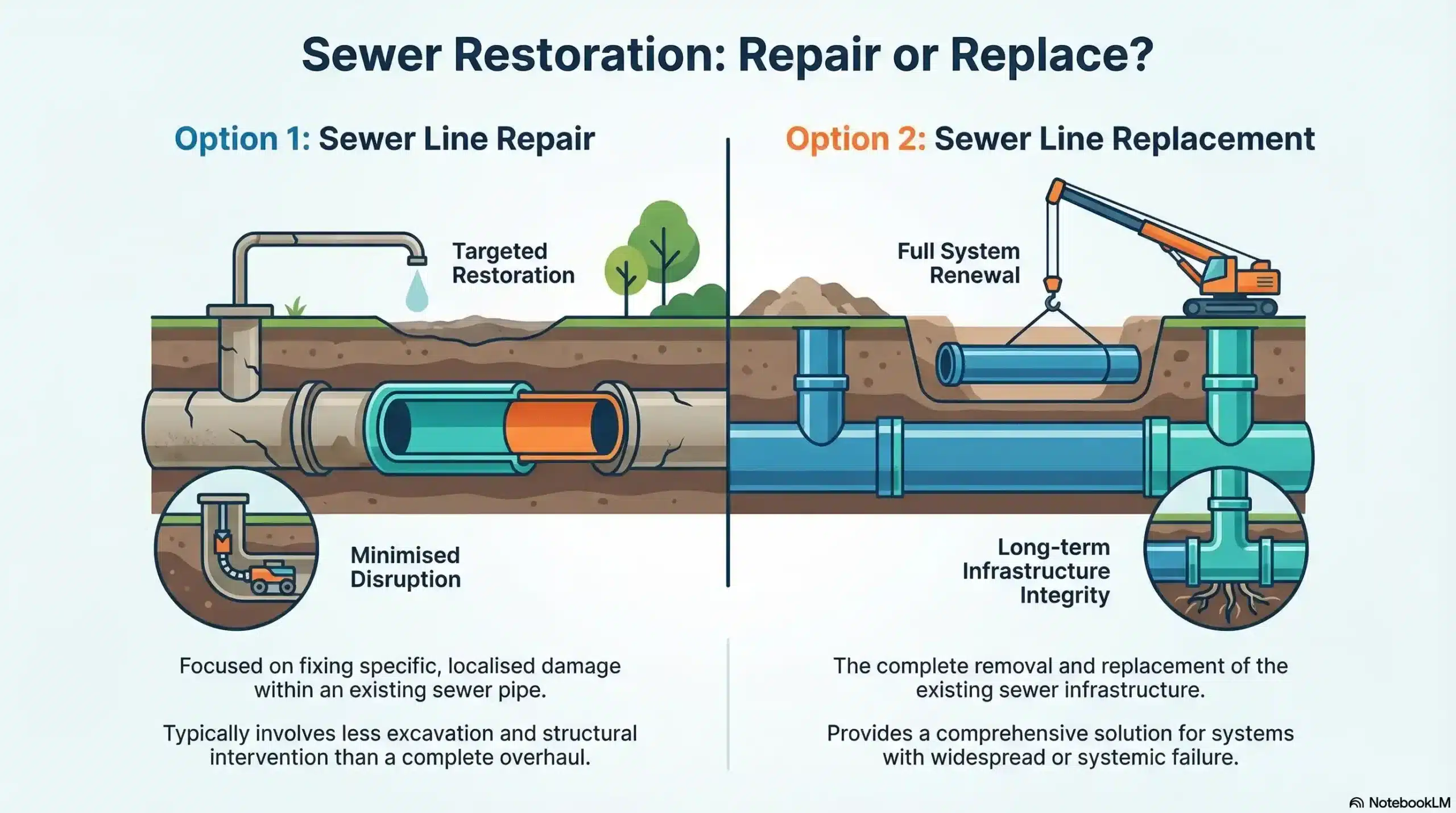
One of the most important and often misunderstood decisions in sewer line work is determining whether your situation calls for a targeted repair or a full replacement. A trustworthy, licensed plumber will always perform a thorough video camera inspection before making this recommendation — and will walk you through exactly what the footage shows.
When Repair Is the Right Call
If the damage to your sewer line is localized to a specific section — a single root intrusion point, one cracked joint, or a small collapse in an otherwise sound pipe — a targeted repair is almost always the more cost-effective and appropriate solution. Repair is also the preferred approach when the pipe material is in good overall condition and the damage is the result of a discrete event rather than systemic deterioration.
When Full Replacement Is Necessary
There are situations where repair is simply not the right long-term answer. If a video inspection reveals widespread root intrusion throughout the line, multiple points of collapse or separation, severe corrosion affecting large sections of cast iron pipe, or a line that has been repaired multiple times and continues to fail, a full replacement will deliver better long-term value and reliability. Attempting to patch a fundamentally compromised line is a short-term fix that will cost more in the long run.
| Decision Factor | Choose Repair | Choose Replacement |
|---|---|---|
| Damage Scope | Localized — single section | Widespread — multiple sections |
| Pipe Condition | Generally sound, isolated failure | Corroded, collapsed, or brittle throughout |
| Repair History | First or second issue | Repeated failures over time |
| Pipe Age | Newer PVC or relatively young line | Pre-1980 cast iron or clay pipe |
| Root Intrusion | Single entry point | Systemic root infiltration |
| Cost Efficiency | Lower upfront cost | Higher upfront, lower long-term |
| Recommended Action | Targeted repair or spot relining | Full replacement — traditional or trenchless |
4. Trenchless vs. Traditional Sewer Repair: What’s the Difference?
The method used to repair or replace your sewer line has a significant impact on cost, timeline, yard disruption, and long-term performance. Understanding your options empowers you to have an informed conversation with your plumber.
Traditional open-cut repair involves excavating a trench along the length of the damaged pipe to access it directly. This method is sometimes necessary — particularly when a line has fully collapsed or when access to the pipe requires significant excavation regardless. While effective, it is the most disruptive approach, requiring restoration of landscaping, concrete, or hardscaping above the line.
Trenchless pipe relining is a modern method that inserts a resin-saturated liner into the existing damaged pipe. Once cured, this liner forms a new, smooth pipe wall inside the old one — sealing cracks, blocking root entry points, and restoring flow capacity with minimal surface disruption. It is an excellent option for pipes that are damaged but still structurally intact enough to serve as a host.
Trenchless pipe bursting is used when the existing pipe needs to be fully replaced rather than lined. A bursting head is pulled through the old pipe, simultaneously fracturing it outward while pulling a new pipe into place behind it. This method replaces the entire line with minimal excavation — typically only requiring small access pits at each end.
Each method has legitimate applications. A qualified master plumber will recommend the approach that best serves the specific condition of your line — not the approach that is easiest or most profitable.
5. How Much Does Sewer Line Repair Cost in Northern Colorado?
Cost is almost always the first question homeowners ask, and it deserves a direct, honest answer. Sewer line repair pricing in the Greeley area is influenced by several variables, which is why any estimate given without a camera inspection should be treated with caution.
Key Factors That Influence Your Final Cost
The depth of your sewer line is one of the most significant cost drivers — deeper lines require more labor and equipment to access. The length of the damaged section directly affects material costs. Whether your line runs beneath concrete, hardscaping, or established landscaping will affect excavation difficulty and restoration costs. The age and material of your pipe influences both the repair method available and the complexity of the work. Finally, permit requirements in Greeley and Weld County may add to the overall project cost, though they are a non-negotiable protection for the homeowner.
Typical Cost Ranges for Greeley, CO Homeowners

| Service | Typical Cost Range | Notes |
|---|---|---|
| Video Camera Inspection | $150 – $400 | Required before any accurate quote |
| Minor Sewer Line Repair | $1,500 – $3,500 | Localized damage, single section |
| Partial Sewer Line Replacement | $3,500 – $6,000 | Multiple sections, moderate damage |
| Full Sewer Line Replacement (Traditional) | $6,000 – $12,000+ | Open-cut, full line |
| Trenchless Pipe Relining | $4,000 – $8,000 | Minimal yard disruption |
| Trenchless Pipe Bursting | $4,500 – $9,000 | Full replacement, minimal excavation |
Note: These are regional estimates for Northern Colorado. Your final cost will depend on the specific conditions of your property. Always request a written, itemized estimate.
💰 No Surprise Bills. Just Honest Estimates.
At Top-Notch Plumbing, Heating & Air, we believe you deserve a clear, transparent estimate before any work begins. Our licensed master plumbers will inspect your line, show you exactly what they find, and give you straightforward options — never high-pressure sales tactics.
Call for your estimate: (970) 404-7586 📍 3005 W. 29th St. Unit D, Greeley, CO 80631 | Financing available for qualifying projects.
6. How to Choose the Right Sewer Line Plumber in Greeley, CO
With your home and your budget on the line, choosing the right plumber is every bit as important as choosing the right repair method. Here are five essential standards every Northern Colorado homeowner should apply before hiring anyone to touch their sewer line.
1. Verify Colorado licensure. In Colorado, any contractor performing sewer line work should hold a valid plumbing contractor license. For complex work, the involvement of a licensed master plumber is the highest standard of assurance. Ask for license numbers and verify them — a trustworthy contractor will provide them without hesitation.
2. Demand a camera inspection before any quote. A professional plumber should never quote sewer line repair without first performing a video inspection. Any contractor who offers a firm price based solely on your description of symptoms is guessing — and you will likely pay for that guess one way or another.
3. Ask for a written warranty on labor. Quality workmanship should be backed by a written guarantee. A contractor who stands behind their work will have no hesitation offering one. A contractor who hedges or avoids this conversation is sending you a clear signal.
4. Watch for red flags. High-pressure urgency tactics, vague or verbal-only estimates, inability to provide license numbers, and an unwillingness to explain the repair process in plain language are all warning signs that should send you to the next option on your list.
5. Choose local and community-rooted. A locally owned plumbing company has its reputation staked on every job it completes in your neighborhood. National chains and out-of-area contractors do not have the same investment in your community’s trust. When a Greeley-based company has been voted best in the city five years in a row, that record speaks louder than any advertisement.
7. Why Northern Colorado Homeowners Trust Top-Notch Plumbing, Heating & Air
When Greeley homeowners face a sewer line emergency, there is a reason they call Top-Notch Plumbing, Heating & Air — and keep calling back.
The Top-Notch team brings over 60 years of combined experience to every job, with three Colorado licensed master plumbers on staff. Their drain and sewer division is led by Jeremiah, a Certified Operator & Jetter through the International Institute of Sewer & Pipe Cleaning (IIISPC #3471) — a specialized credential that represents the highest standard of professional drain and sewer expertise.
The community has noticed. Top-Notch has been voted “Greeley’s Best Plumber” for five consecutive years — 2020, 2021, 2022, 2023, and 2024 — a testament to the consistent, quality service that has earned the trust of thousands of Northern Colorado homeowners. The company is also a recognized vendor for the City of Greeley and Greeley’s ATMOS, reflecting an institutional level of trust that goes well beyond standard business credentials.
Every job performed by Top-Notch is backed by a comprehensive 1-year labor warranty — because confidence in your own work is the most honest guarantee a company can offer. Financing is available for qualifying projects, and the company proudly offers a 10% First Responders Discount for Firefighters, Paramedics, Police Officers, and Flight for Life Pilots in recognition of their service to the community.
Top-Notch serves Greeley, Evans, Loveland, and all of Northern Colorado, Monday through Friday from 7:00 AM to 4:30 PM.
🏛️ Local Resources & Citations
1. City of Greeley — Permits, Licenses & Inspections. Check here to understand what permits are required before sewer line repair or replacement work begins on your Greeley property — a licensed contractor should pull this permit on your behalf.
2. City of Greeley — Water & Sewer Department. The official source for reporting sewer emergencies, understanding your connection to the city’s public sewer system, and contacting Greeley’s utility department directly at 970-350-9811.
3. Colorado DORA — Verify a Plumber’s License. Use this free tool to instantly verify that any plumbing contractor you hire holds a current, active Colorado state license — the most important step in protecting yourself before work begins.
4. Weld County Environmental Health Services — Septic & Sewer Systems. Essential for homeowners outside Greeley city limits — this office oversees permitting, inspections, and repair approvals for on-site wastewater and sewer systems throughout Weld County.
🏆 Greeley’s #1 Rated Plumber — 5 Years Running
Your sewer line is too important to trust to anyone but the best. The licensed, experienced team at Top-Notch Plumbing, Heating & Air is ready to inspect, diagnose, and solve your sewer line problem the right way — with honesty, expertise, and a written warranty to back it up.
📞 Call Today: (970) 404-7586 📍 3005 W. 29th St. Unit D, Greeley, CO 80631 🕐 Monday–Friday | 7:00 AM – 4:30 PM | Financing Available
Frequently Asked Questions
-
Costs vary based on the damage:
-
Cleanouts/Hydro-jetting: $200 – $800
-
Trenchless Lining: $4,000 – $8,000
-
Full Excavation: $6,000 – $15,000+ Always get multiple local estimates.
-